
The pharmaceutical retail chain does not have a technology problem. It has a coordination problem that technology has never properly addressed.
Walk into any mid-size pharmacy chain's back office and you find the same pattern: remittance submitted on a spreadsheet at the end of the day, procurement triggered by a manager's judgment when shelves look thin, supplier payments sitting in a queue waiting for someone to review the invoice. Branch A is out of Amoxicillin. Branch B is about to expire its surplus. Nobody knows. Nobody acts.
The infrastructure failure here is not just inefficiency — it is the complete absence of a trusted coordination layer between procurement, inventory, inter-branch operations, and financial settlement. The global pharmaceutical retail market exceeds $1.4 trillion annually. Chains are losing billions not because they lack inventory software, but because the software they run does not talk to anything and enforces nothing.
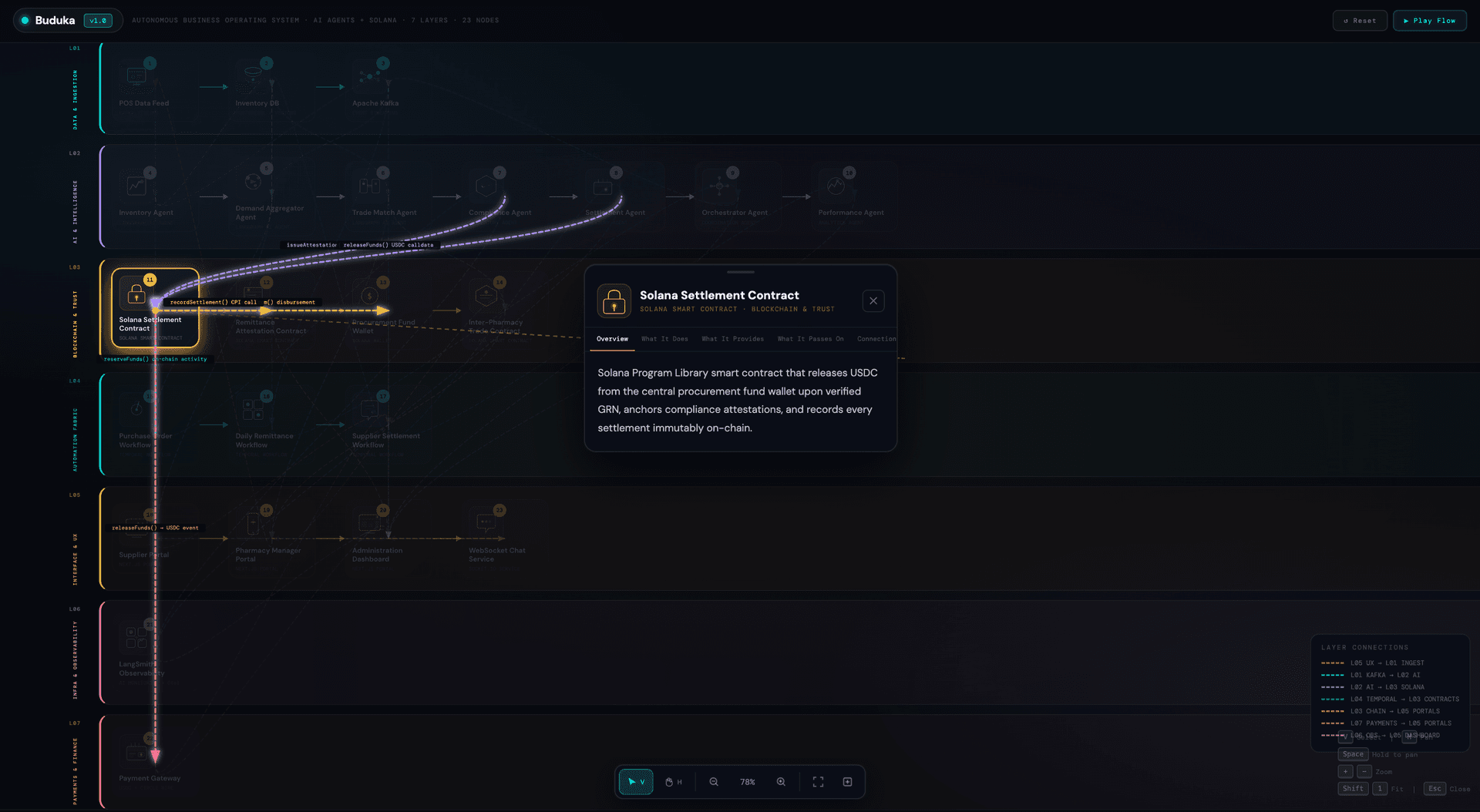
Buduka is the system I would build to fix this. A seven-layer Autonomous Business Operating System that replaces every manual bottleneck from low-stock detection to supplier payment with AI reasoning, durable automation, and on-chain settlement. Here is the architecture.
The Infrastructure Problem
The specific failure point in pharmaceutical retail is not stockouts. Stockouts are a symptom. The root cause is that no system currently coordinates the chain as a single operational unit.
Every branch runs as an island. POS data stays in the branch system. Procurement decisions get made by individual managers working from memory and gut feel. When a branch finally submits its daily remittance, it goes into a spreadsheet — and if the numbers are disputed two weeks later, there is no immutable record to resolve the disagreement. No audit trail. No chain-wide visibility into what was ordered, what was delivered, and what was paid. The data exists in fragments. The trust infrastructure does not exist at all.
The supplier side is equally broken. Suppliers deliver goods and wait weeks for payment because the settlement workflow depends on a human reviewing an invoice, matching it to a delivery, and approving a bank transfer. That process fails on volume. It fails on speed. It generates disputes that get resolved by email, documented nowhere, and forgotten before the next cycle. Meanwhile, the supplier's performance — on-time rate, GRN accuracy, pricing compliance — is never tracked in any structured way. Poor suppliers stay on the list. Good ones get no advantage.
The financial reconciliation problem is the one most chains refuse to confront directly. When a pharmacy manager submits remittance, the amount is taken on trust. There is no automated cross-check against POS totals. Discrepancies surface slowly if at all. And because nothing is blockchain-attested, there is no tamper-proof record to anchor a compliance audit. Regulators asking for a three-year procurement history get a spreadsheet archive that nobody can fully trust.
This is not a problem of lacking the right ERP system. It is a problem of lacking the right infrastructure design — one that treats AI coordination, workflow durability, and on-chain trust as first-class requirements rather than optional add-ons.
The Autonomous Pharmaceutical Retail Operating System
Buduka is structured as seven distinct layers. Each layer has a specific function. Each layer connects to the next with defined data contracts. Nothing is coupled by coincidence.
You can watch the full step-by-step breakdown of the architecture and user journey in the video below, or explore the full playlist covering different system architectures.
L01 — Data & Ingestion
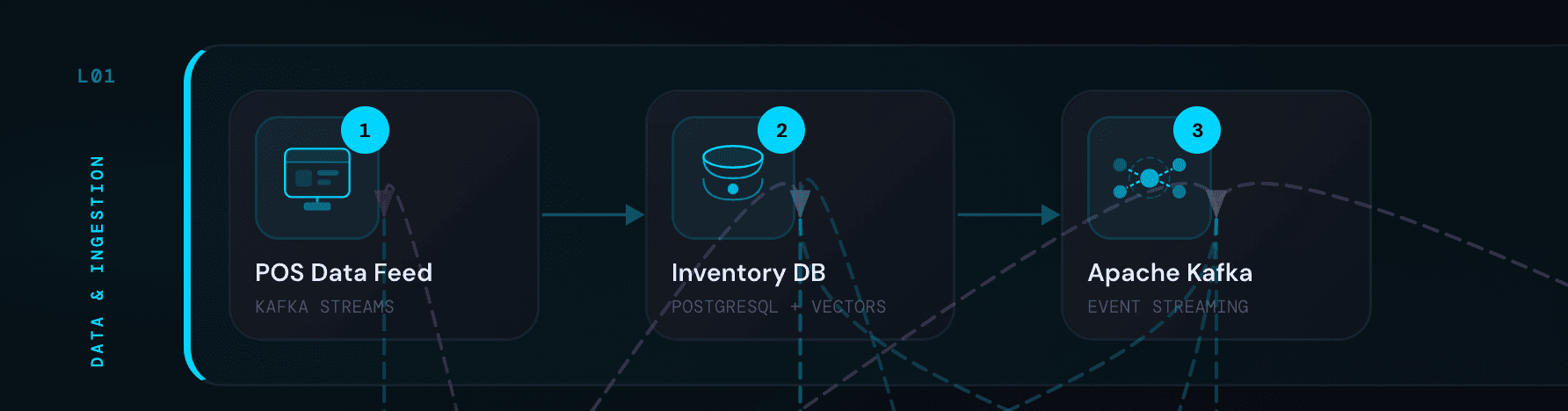
This layer feeds the entire system. Three nodes operate here: the POS Data Feed, the Inventory DB, and Apache Kafka.
POS transactions stream in real time. Inventory state is maintained in a structured database with per-branch, per-SKU visibility. Kafka carries every event — stock movements, sales records, reorder signals — through the system with no batch delay and no nightly sync. When stock drops below reorder point at any branch, the event fires instantly. The AI layer receives it within milliseconds.
The significance of this layer is not the technology. It is the design decision to treat the entire chain as a single event stream rather than a collection of disconnected branch databases. That is the foundational shift that makes everything downstream possible.
L02 — AI & Intelligence

Seven LangGraph-based agents operate in this layer. Each has a defined persona, a constrained toolset, and a validated output schema. No agent outputs freeform text into the system — every decision is structured and machine-readable.
The Inventory Agent monitors every branch continuously. When stock at any branch crosses the reorder threshold, it generates a Branch Order Request with SKU IDs and quantities. The Demand Aggregator Agent collects all branch requests within a six-hour aggregation window and produces a chain-wide demand profile. The Trade Match Agent scans simultaneously for surplus and shortage patterns across branches and proposes net-zero inter-branch transfers. The Compliance Agent verifies every supplier's regulatory attestation before any order is allocated. The Settlement Agent handles GRN verification and constructs payment instructions. The Performance Agent scores suppliers live on delivery rate, accuracy, and compliance. The Orchestrator Agent arbitrates inter-agent conflicts and routes escalations to the correct human actor.
No manager approves a routine reorder. No supervisor manually matches a supplier invoice. The agents handle this. Human judgment enters the system only at escalation gates — high-value purchase orders that exceed autonomous spend thresholds, trade proposals waiting for manager confirmation, remittance discrepancies that require an explanation.
L03 — Blockchain & Trust
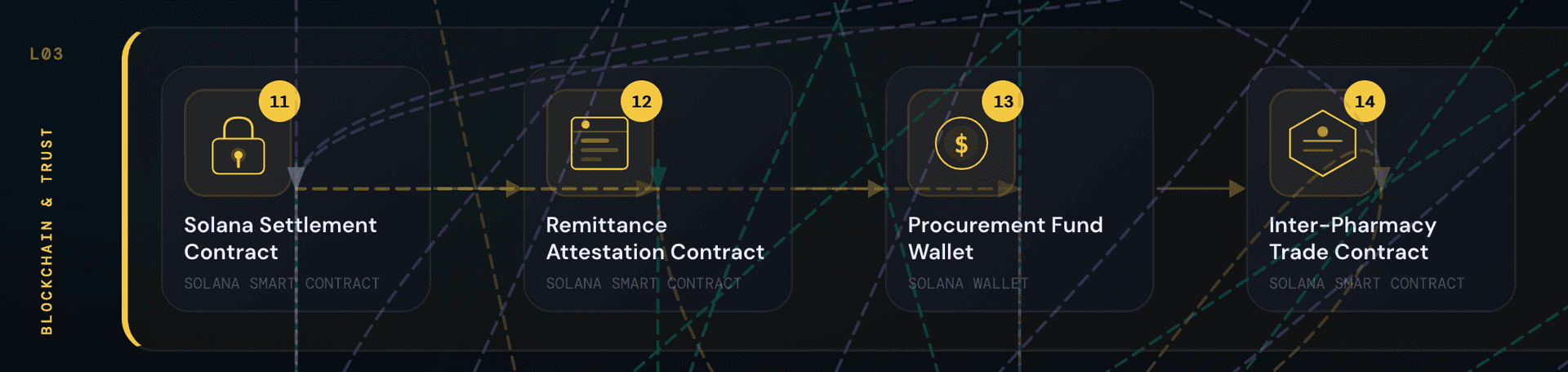
This is where the system earns its credibility. Four Solana smart contracts anchor every consequential operational and financial event.
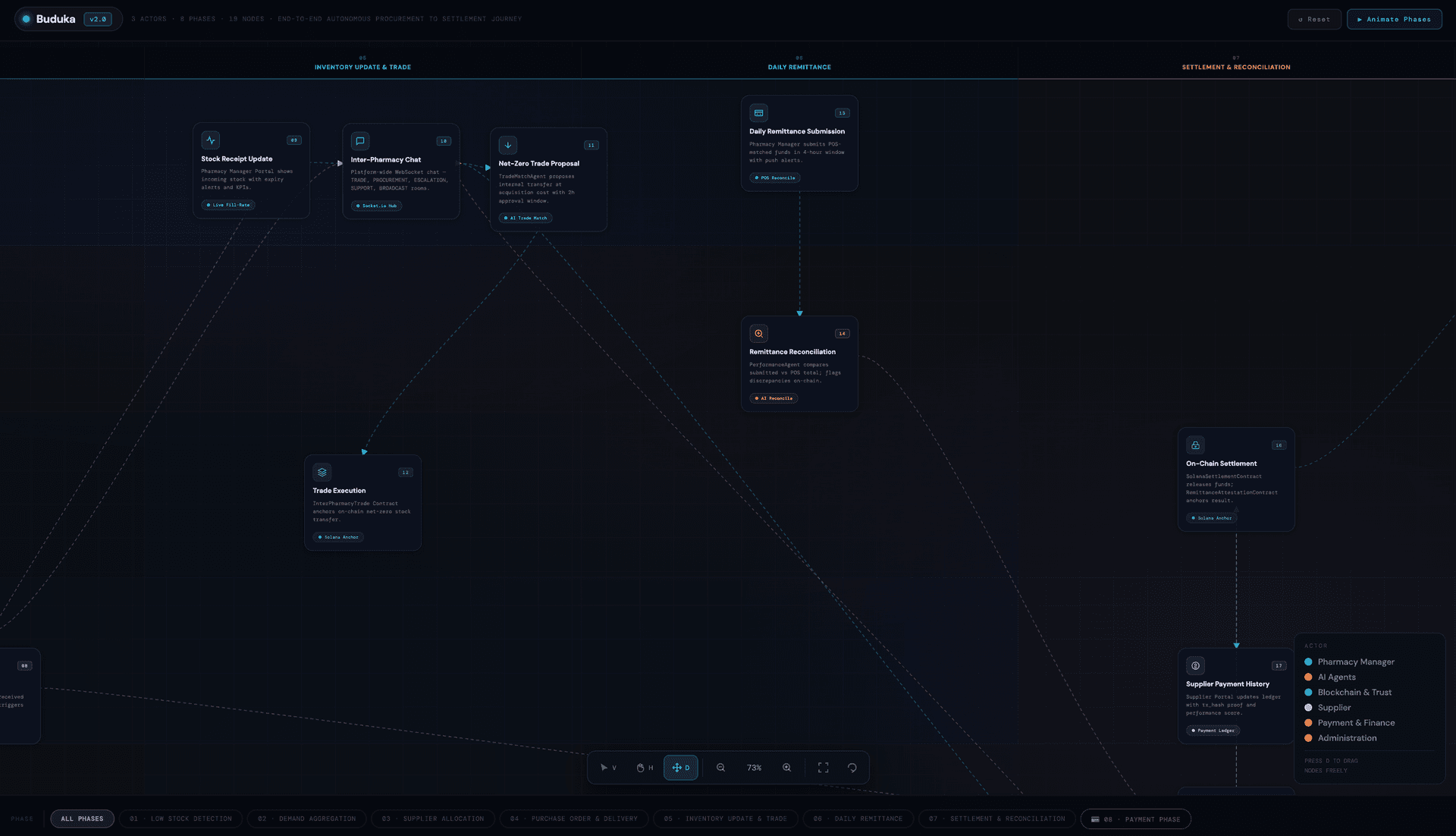
The Solana Settlement Contract locks and releases USDC from the central procurement fund wallet — every fund reservation on PO creation and every release on GRN confirmation is on-chain. The Remittance Attestation Contract records the hash of every daily reconciliation result — branch ID, date, POS total, submitted amount, and status — immutably on Solana). The Procurement Fund Wallet is a program-derived address controlled exclusively by the Settlement Contract, holding central procurement capital with a real-time burn rate visible to Administration.
The Inter-Pharmacy Trade Contract anchors every net-zero inter-branch stock transfer with multi-sig confirmation from both branch managers.
The business argument for this layer is precise: when a supplier disputes a payment, when a regulator requests a compliance audit, when a branch manager contests a remittance shortfall, the answer is not a spreadsheet. It is a blockchain transaction hash with a timestamp that nobody altered.
L04 — Automation Fabric
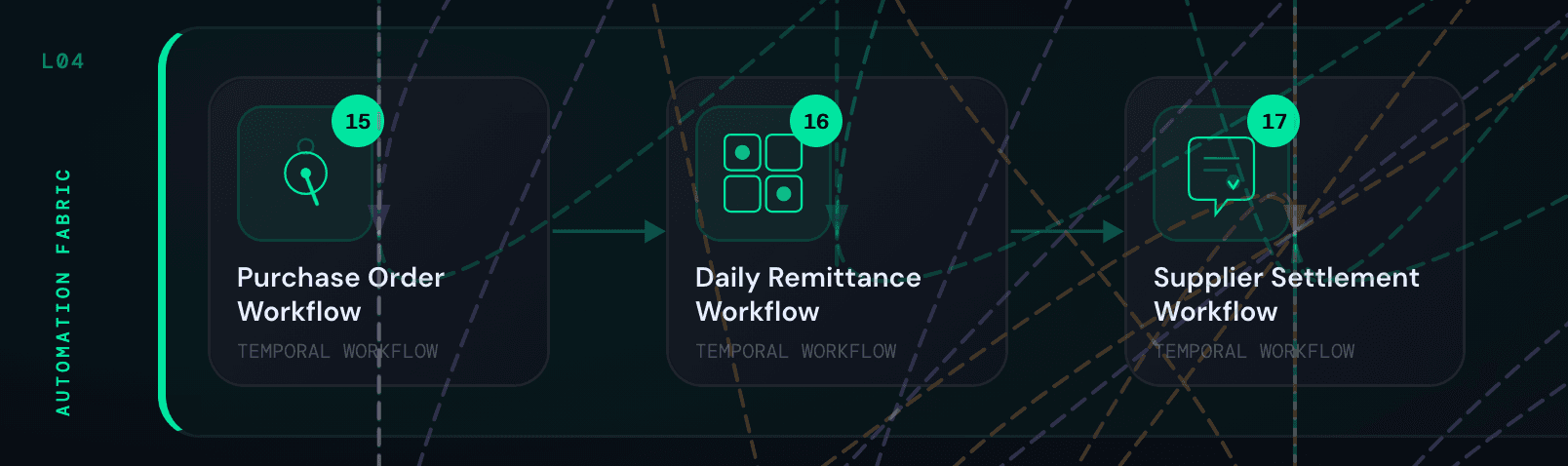
Temporal-powered durable workflows operate here. Three primary workflows run on exactly-once execution semantics: Purchase Order Workflow, Daily Remittance Workflow, and Supplier Settlement Workflow.
The Purchase Order Workflow generates and reserves procurement funds the moment a supplier confirms their allocation. The Daily Remittance Workflow fires at 18:00 UTC for every active branch simultaneously — fetching POS totals, notifying the Pharmacy Manager, waiting for remittance submission, reconciling the result, and anchoring the outcome on-chain. The Supplier Settlement Workflow triggers on GRN (Goods Received Note) confirmation and orchestrates the end-to-end payment process through the Payment Gateway.
The design requirement for this layer is durability. Temporal workflows survive infrastructure restarts, retry failures automatically, and never lose state. An AI decision that triggers a workflow does not depend on the application server staying healthy. The workflow runs to completion regardless.
L05 — Interface & UX
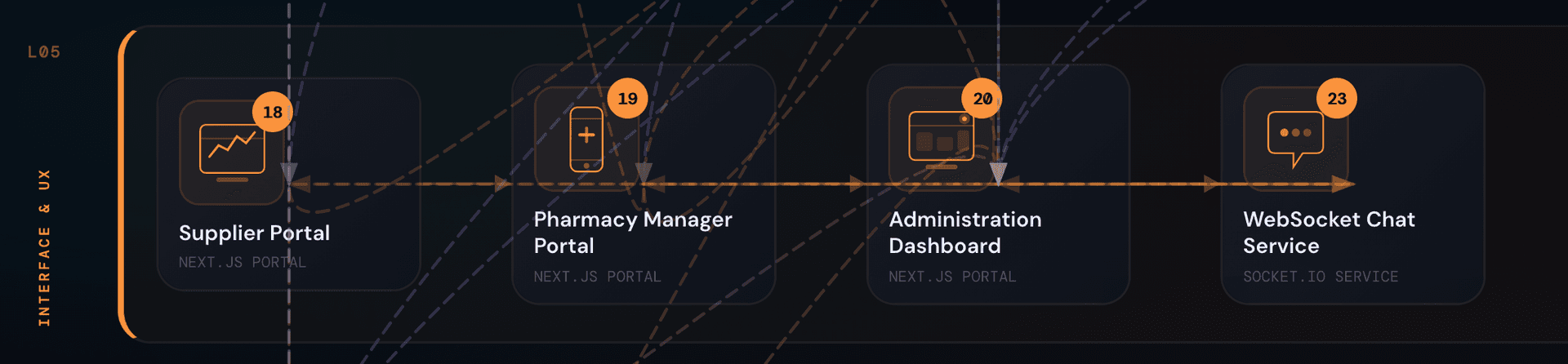
Three Next.js portals serve the three actor classes. The Supplier Portal surfaces aggregated chain-wide demand by SKU — without exposing individual branch data — and handles GRN submission and payment history. The Pharmacy Manager Portal shows branch stock, incoming purchase orders, remittance status, and inter-pharmacy trade options. The Administration Dashboard controls procurement fund status, daily remittance scoreboards, supplier KPI tables, escalation queues, and chain-wide policy parameters.
A Socket.io *WebSocket Chat Service sits alongside the three portals in this layer — correctly classified as an interface component, not a financial one.
Five room types operate on the hub:
Room lifecycle is event-driven — rooms auto-open on operational triggers and auto-close when the linked entity reaches terminal state.
L06 — Infra & Observability
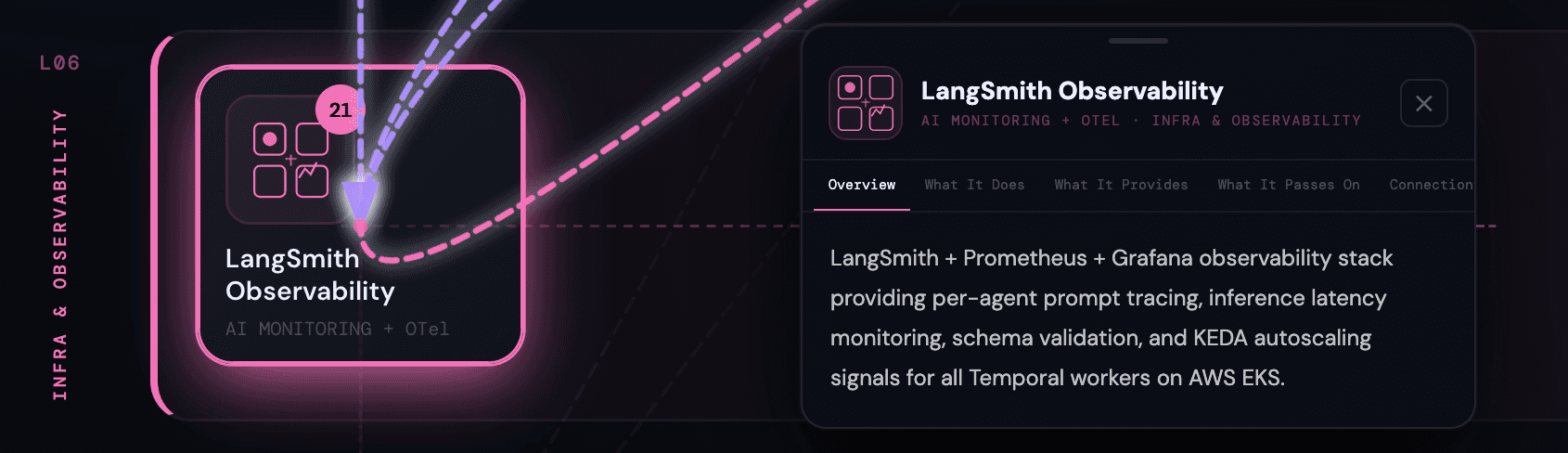
LangSmith runs the observability) layer. Every agent inference, every workflow execution, and every on-chain transaction emits structured telemetry here.
The system traces complete LangGraph run trees per agent — prompt, structured output, tool call latency, schema validation pass/fail. Alert callbacks trigger the Orchestrator Agent when schema violation rates exceed defined thresholds. The Administration Dashboard receives a live agent health feed pushed by LangSmith webhooks. Without this layer, diagnosing why an allocation decision deviated from expected behavior requires guesswork. With it, the exact reasoning chain is traceable from the triggering event to the final output.
L07 — Payments & Finance
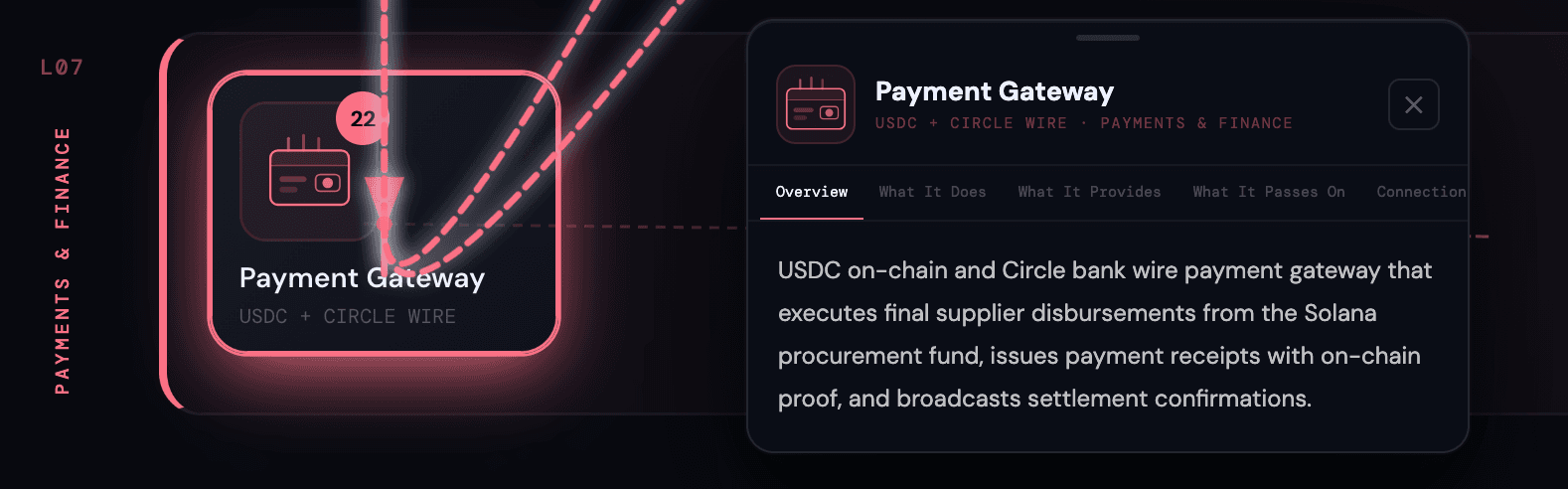
A dedicated Payment Gateway node sits here alongside the Solana contracts. This is an intentional architectural boundary — payment execution logic is separated from the smart contract layer. The Gateway listens for USDC disbursement events from the Settlement Contract, executes on-chain transfers for suppliers with Solana wallets (sub-500ms finality), and initiates Circle bank wires for fiat-payment suppliers. Every payment is signed through a [CloudHSM](https://en.wikipedia.org/wiki/Hardware_security_module)-backed enterprise wallet. The Gateway broadcasts payment confirmation to the Supplier Portal and the Administration Dashboard simultaneously, and sends a completion signal to the Settlement Workflow to close the GRN lifecycle.
Complete System Flow
1. Demand Detection
Branch POS Event
→ Kafka Ingestion
→ InventoryAgent detects stock movement
→ DemandAggregatorAgent consolidates demand across branches
2. Supplier Allocation
Demand signal
→ Supplier allocation engine selects supplier
→ Supplier Portal confirmation
3. Purchase Order Execution
Supplier confirmation
→ PurchaseOrderWorkflow triggered
→ Funds reserved on-chain
4. Delivery & Inventory Verification
Supplier delivery
→ Goods Received Note (GRN) confirmation
5. Financial Settlement
GRN confirmation
→ SettlementAgent verification
→ Payment Gateway execution
→ USDC settlement
6. Compliance & Audit
Settlement completion
→ Remittance attestation recorded
→ LangSmith audit trail logged
Nothing in that chain waits for a human signature unless a policy threshold demands one.
User Experience — How Each Stakeholder Operates
The Pharmacy Manager previously ran on a combination of shelf observation, manual reorder emails, and daily spreadsheet remittance. They had no visibility into whether the supplier had received their order, no knowledge of which neighboring branch was sitting on surplus of what they needed, and no confirmation that the payment they submitted matched what the system recorded. With Buduka, their dashboard shows real-time branch stock, incoming order status, and active trade options. The Inventory Agent handles routine reorders autonomously. When an order requires approval, the Manager gets a time-gated escalation — approve or reject within a defined window, after which inaction routes to Administration. Daily remittance is submitted through the platform, cross-checked against POS totals automatically, and anchored on-chain. The manager's operational cognitive load drops to exception handling.
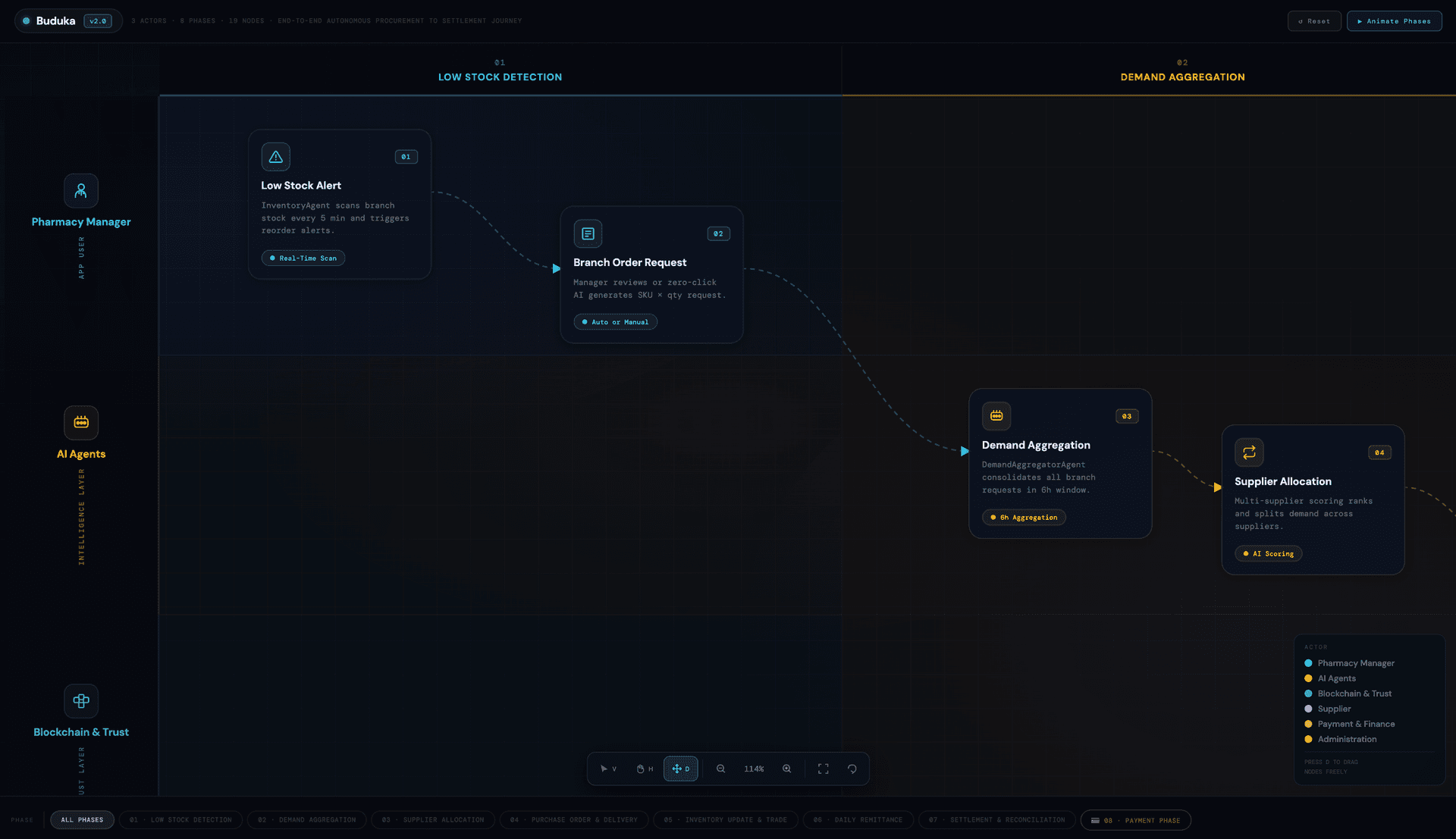
The Supplier previously received orders by email or EDI, delivered goods, raised an invoice, and waited. Payment timelines were unpredictable. Disputes about delivery quantities went back and forth with no formal resolution mechanism. With Buduka, the Supplier Portal shows their allocated demand before an order is formally issued — enabling logistics planning. Once goods are delivered and GRN is confirmed, the Payment Gateway executes within milliseconds for USDC-enabled suppliers, or initiates a Circle wire within standard banking windows. Every settlement has a blockchain transaction hash. Every dispute has a SUPPORT chat room with a linked GRN record. Performance scores update in real time, and a supplier's allocation weight in future orders reflects their actual track record.
Administration previously operated on reports — end-of-week summaries, month-end reconciliation reviews, quarterly supplier assessments. The data was backward-looking and could not be trusted entirely because it was assembled manually. With Buduka, Administration operates on live infrastructure. Procurement fund balance updates in real time with burn rate and runway projections. Daily remittance scoreboards show every branch's status by 22:00. Supplier KPI tables are scored continuously. Policy parameters — autonomous spend caps, allocation weights, reorder thresholds — are configured through the dashboard and enforced by the agents without manual follow-up.
The Business Case
The revenue model has five legs and a clear moat. SaaS licensing per pharmacy branch provides predictable recurring revenue that scales with the size of the chain — not with transaction volume. Per-transaction infrastructure fees on USDC) settlements through the Payment Gateway attach revenue directly to the operational utility the system provides. Enterprise licensing for chains with 20 or more branches captures the segment with the highest willingness to pay, since larger chains carry the largest operational risk from the status quo. Compliance and operational data products sold to regulators and auditors convert the immutable on-chain records into a standalone revenue stream — audit-grade supply chain attestation is a regulated product category in most jurisdictions. Implementation consulting for chains adopting the system covers onboarding complexity and creates a high-value professional services layer.
The defensibility argument is not speculative. Every month a chain runs on Buduka, it accumulates on-chain attestation records, supplier performance histories, branch remittance patterns, and procurement baselines. That data set becomes the chain's operational intelligence layer. Switching to a competitor means abandoning that history. The network effect applies to the supplier side as well — suppliers onboarded into the Buduka ecosystem are scored, attested, and integrated. Re-onboarding them into a competing system carries real cost and compliance friction.
For investors evaluating autonomous business systems infrastructure, the signal here is architectural. This is not workflow automation layered on top of an existing ERP. This is a purpose-built operating system that replaces the coordination layer entirely. The switching cost is the point. The data moat is the compounding asset.
Strategic Considerations & Real Challenges
The hardest adoption challenge is not technical. It is organizational. Pharmacy chain managers who built their careers on judgment-based procurement and relationship-based supplier management do not readily hand decision authority to an AI agent. The mitigation is not to argue that the AI is better than they are — it is to position Buduka as the system that handles the volume they cannot, while preserving their role for escalations, exceptions, and strategic decisions. Autonomous for routine. Human for consequential. That framing changes the adoption conversation.
Regulatory complexity across different markets is real. Blockchain pharmaceutical logistics intersects with data residency requirements, controlled substance handling rules, and financial settlement regulations that vary by jurisdiction. The Compliance Agent's on-chain attestation model needs to be configured per regulatory environment, and the controlled substance eligibility gate for inter-pharmacy trades is a hard architectural requirement, not a soft rule. Chains operating across multiple regulatory environments need this baked into the system from day one — not bolted on later.
Infrastructure cost is the honest friction point for smaller chains. The Temporal workflow infrastructure, LangSmith observability, CloudHSM wallet security, and Solana settlement layer together represent a meaningful operational baseline cost. The per-branch SaaS model makes this work financially at scale. For chains under ten branches, the ROI calculation requires a clear analysis of current losses from stockouts, reconciliation disputes, and delayed supplier payments — because that is the number the infrastructure cost is measured against, not some abstract efficiency percentage.
The Infrastructure Always Determines the Outcome
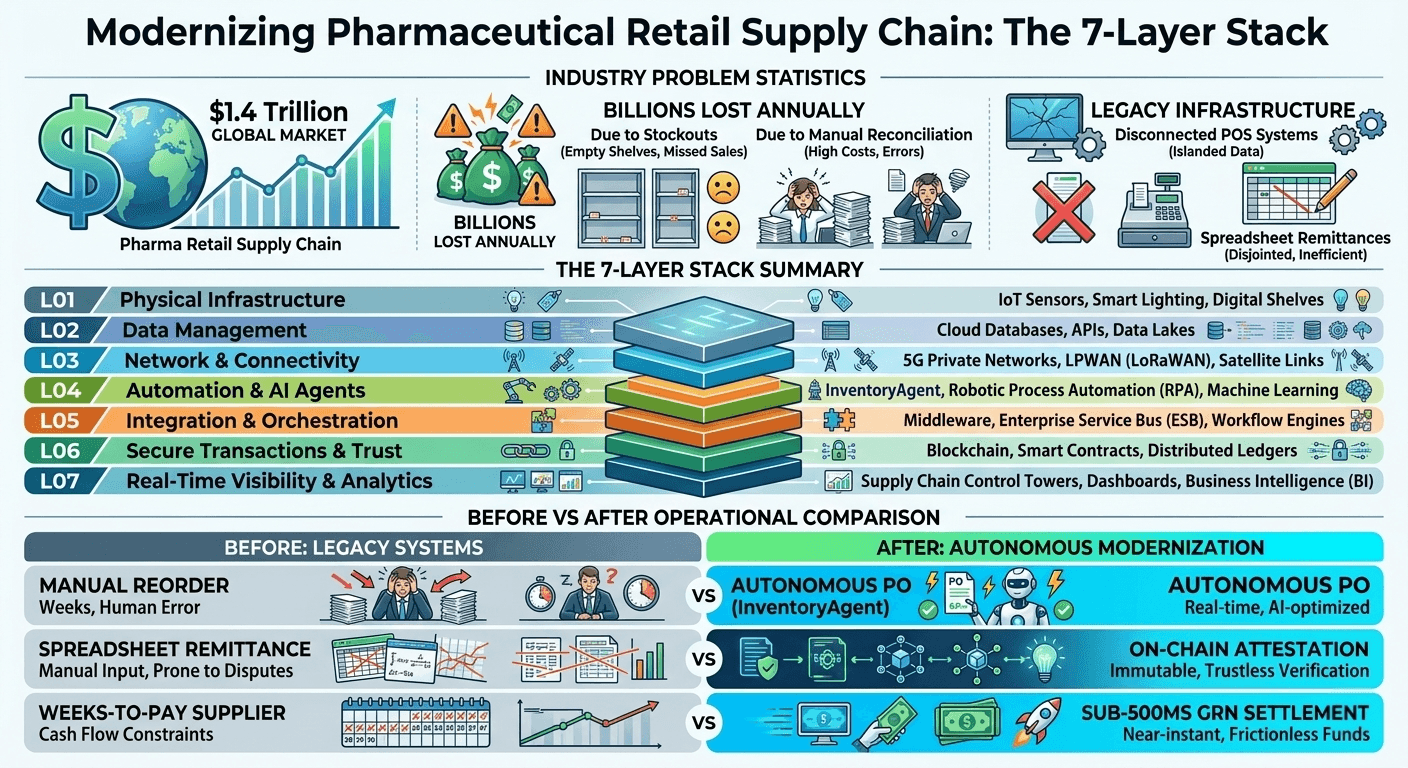
Most pharmaceutical chains will spend the next decade optimizing processes built on fundamentally broken infrastructure. Better spreadsheet templates. Faster email approvals. More responsive supplier portals that still don't talk to the settlement layer. The operational ceiling of that approach is low, and every year spent under it is a year of compounding losses.
Buduka proves a different thesis: that pharmaceutical retail operations are not inherently complex — they are complex because no one designed the coordination layer correctly. When AI agents reason over live chain-wide data, when automation workflows execute without human bottlenecks, and when every financial transaction is blockchain-attested before it closes, the operational picture changes entirely. Stockouts become detectable and preventable in advance. Supplier payments become instant and irrefutable. Remittance disputes become resolved by on-chain evidence rather than negotiated in email.
In three to five years, the chains that built this infrastructure will have compounding data advantages that no late adopter can quickly replicate. The ones still running on spreadsheets will be paying for that gap.
If you want me to design a system like Buduka for your business — an autonomous operating stack that removes manual decisions from your chain operations — the consulting booking link is here: dappmentors.org/consult. Let's build the infrastructure.
About the Author
Darlington Gospel is an AI, Blockchain & Automation Infrastructure Architect and Strategic Technology Analyst. Host of Beyond Blockchain series, and Founder of Dapp Mentors. Writing for enterprise founders, infrastructure startups, technical architects, supply chain operators, investors evaluating infrastructure innovation, and global business strategists.