
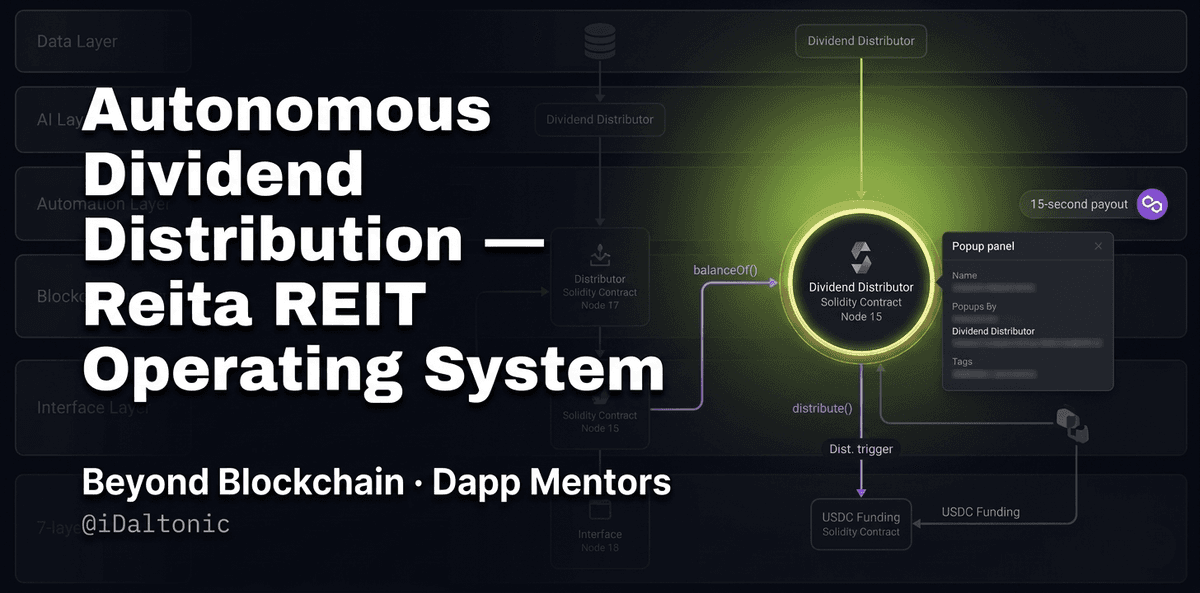
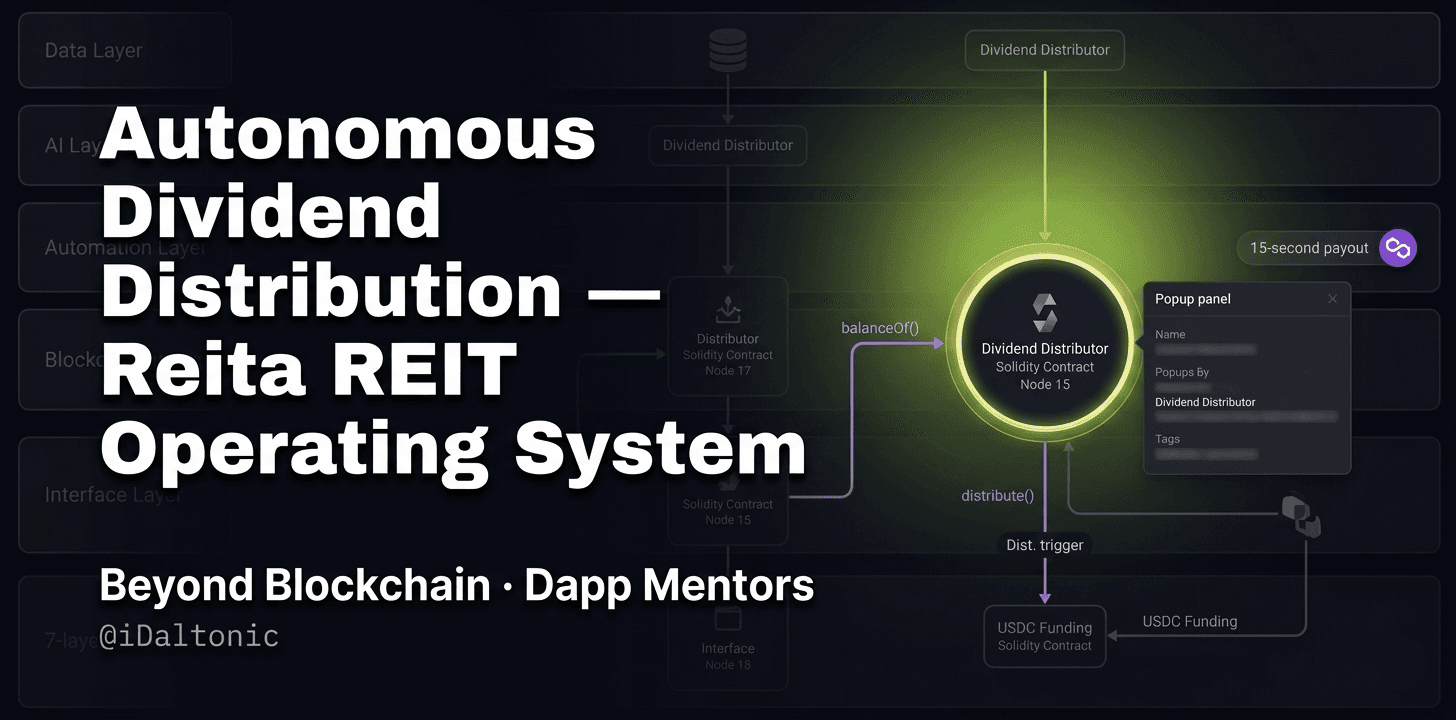
Most real estate investment trusts still run leasing and dividends through spreadsheets and human teams. They think the problem is slow paperwork or high fees.
It is not.
The real gap is blockchain underuse. REIT operators use less than 5% of what blockchain can do for trust and instant settlement. That is not a property management problem. It is a trust and latency problem — and no traditional process upgrade fixes an on-chain settlement problem.
Here is the system I would build to close that gap completely: a closed-loop, 7-layer autonomous AI + blockchain + automation operating system on Polygon PoS that executes the entire REIT lifecycle without intermediaries and pays monthly dividends in under 15 seconds.
The Infrastructure Problem
Traditional REITs have three compounding failures. Manual underwriting takes weeks. Leases need lawyers and paper signatures. Rent collection sits in spreadsheets, and dividends arrive quarterly after wire fees and delays. That costs time, errors, and lost yield — and none of it is a technology limitation. It is a stack design failure.
The deeper issue is coordination trust. When a lease gets executed today, the proof lives in a filing cabinet or a PDF on a shared drive. When rent is collected, the confirmation travels through a bank, a property manager, an accountant, and a wire transfer that takes days to clear. Each handoff is a point where data can be disputed, delayed, or manipulated. The entire system is held together by human intermediaries because no one built the infrastructure that makes intermediaries unnecessary.
Blockchain is the obvious fix — except most REIT operators have never built it in properly. They bolt on a token here, a smart contract there, and call it "tokenized real estate." What they actually have is a traditional REIT with a digital wrapper. The operational logic — the leasing, the rent cycles, the dividend calculations — still runs on the same human-dependent stack underneath.
The fix is not a token. The fix is redesigning the operating system from the ground up so that trust, settlement, and decision-making are all encoded in the infrastructure itself.
The System Architecture: 7-Layer Autonomous REIT Operating System
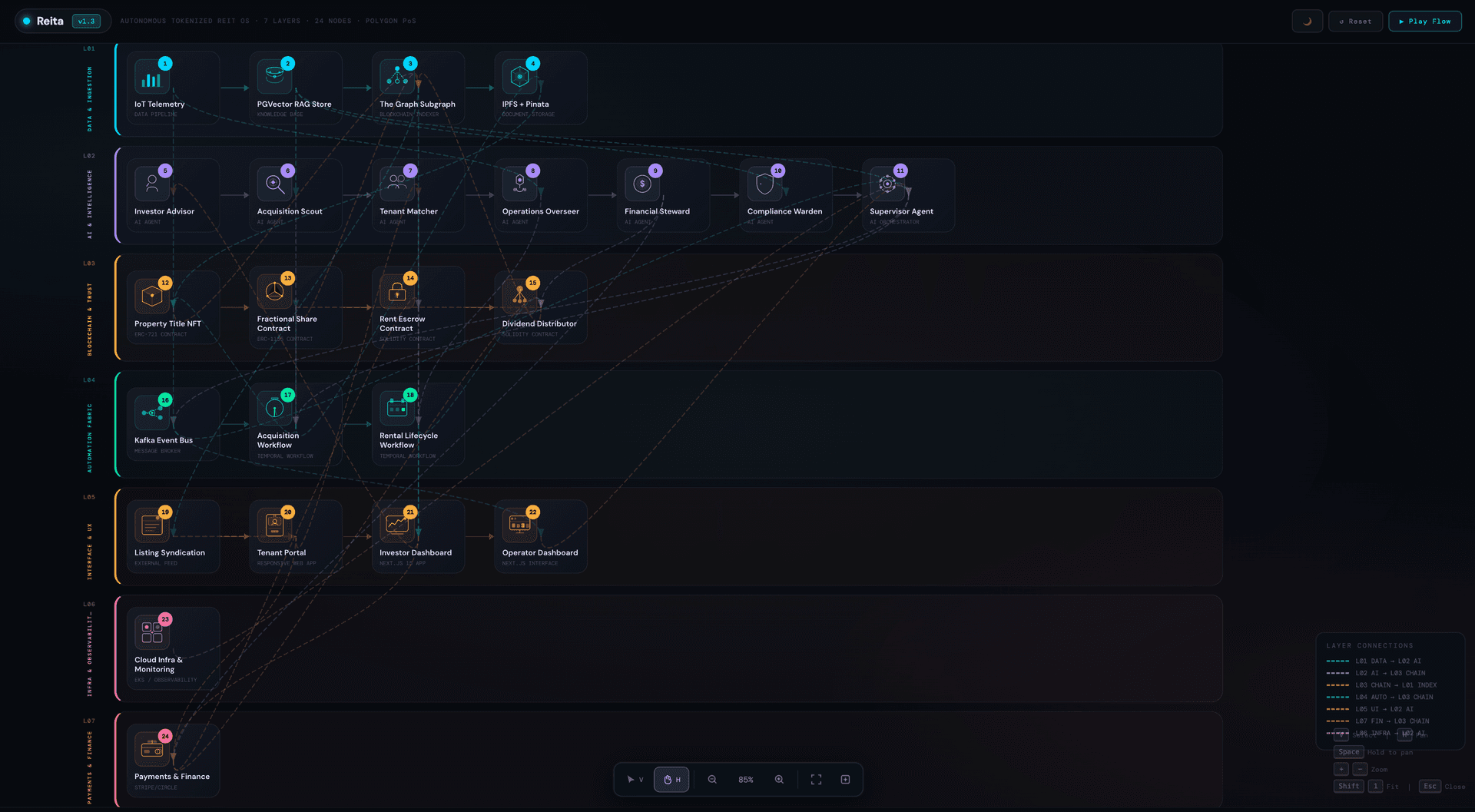
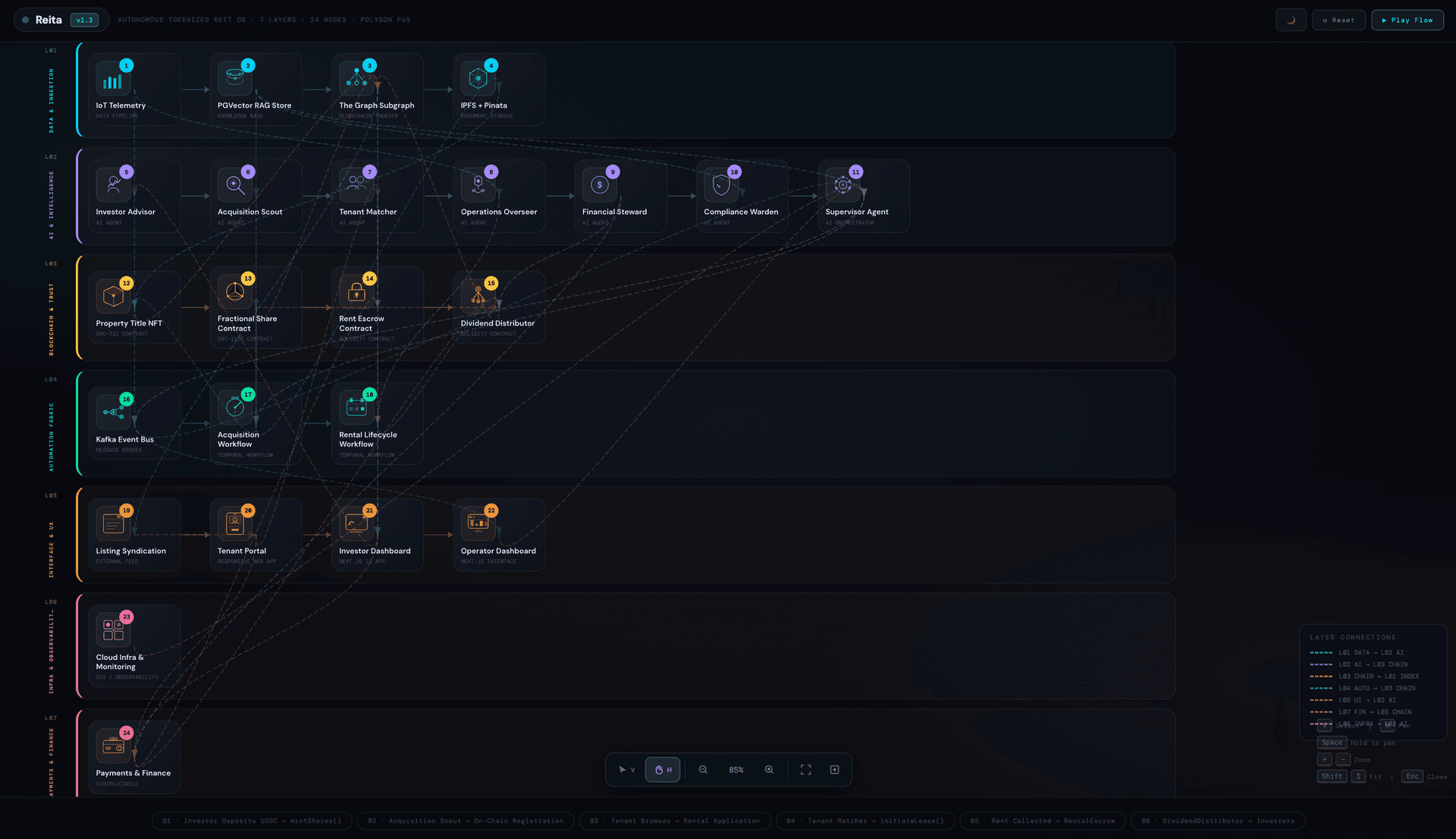
The architecture organises 24 nodes across 7 horizontal layers. Data flows upward from ingestion to intelligence. Decisions flow downward to blockchain settlement. The Automation Fabric connects everything. No layer has a dependency that skips a layer below it.
You can watch the full step-by-step breakdown of the architecture and user journey in the video below, or explore the full playlist covering different system architectures.
Here is what each layer does and why it exists.
L01 — Data & Ingestion

This is the sensory layer. Four nodes handle everything that enters the system: IoT telemetry from property sensors (pushed via MQTT at 1 Hz, normalised into typed events on Kafka), the PGVector RAG Store (a PostgreSQL 16 + PGVector instance holding SEC regulations, lease templates, MLS comparables, and REIT tax rules as searchable vector embeddings), The Graph Subgraph (which indexes all smart contract events on Polygon PoS and exposes a GraphQL API returning portfolio balances in under 200ms), and IPFS + Pinata (decentralised document storage where every lease PDF, property deed, and inspection report is pinned, with a content identifier written on-chain as an immutable reference).
L01 solves the data silo problem that breaks traditional REITs. Every agent in L02 operates from a single, queryable source of truth — not from a spreadsheet someone last updated on Tuesday.
L02 — AI & Intelligence

Seven LangGraph agents run here. Each agent has a defined persona, a constrained toolset, a versioned prompt library, and a deterministic output schema validated by Pydantic. They share no state at runtime. All context is injected via a structured Context Envelope assembled in under 250ms.
The roster:
The business logic here: no human approval delay in the critical path. Decisions drop straight to the blockchain.
L03 — Blockchain & Trust
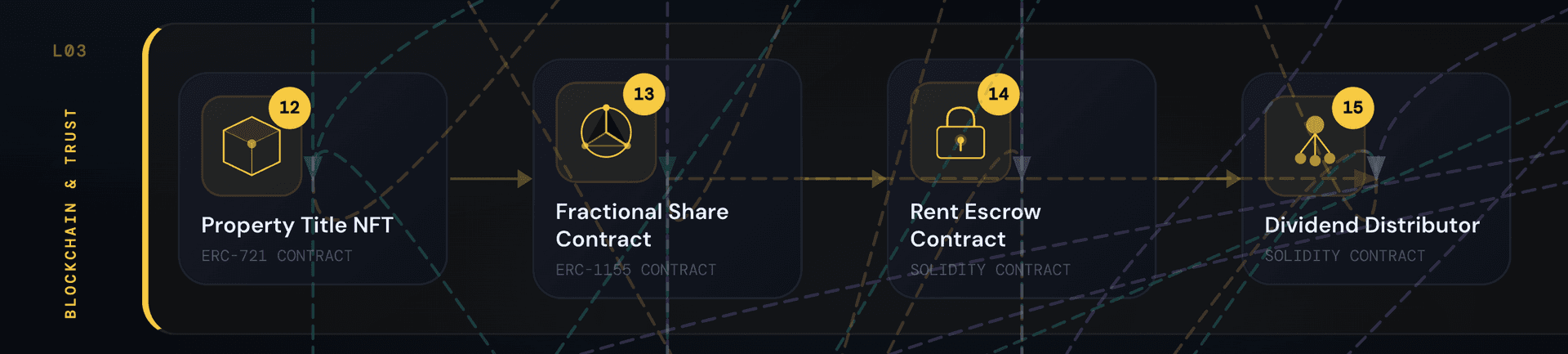
This layer is the legal spine. Four smart contracts on Polygon PoS encode everything that would otherwise live in a law firm's filing cabinet.
ReitaPropertyNFT.sol (ERC-721) is the on-chain property title deed — soulbound to the Reita operations multisig, minted at acquisition close, with the IPFS deed CID embedded in token metadata. FractionalShareContract.sol (ERC-1155) represents divisible investor shares. balanceOf() is used for real-time dividend calculation. Every secondary transfer is tracked on-chain at 0.3% fee. RentEscrowContract.sol is the neutral vault that receives USDC rent, holds security deposits, and enforces a 48-hour dispute window before releasing funds. DividendDistributor.sol is the gas-optimised batch payout contract that distributes pro-rata rental income to all fractional shareholders on Polygon PoS — 5-second finality means investors see USDC in their wallets within 15 seconds of the distribution call.This is where the blockchain underuse problem ends. No spreadsheets. No intermediaries. The contract is the law.
L04 — Automation Fabric
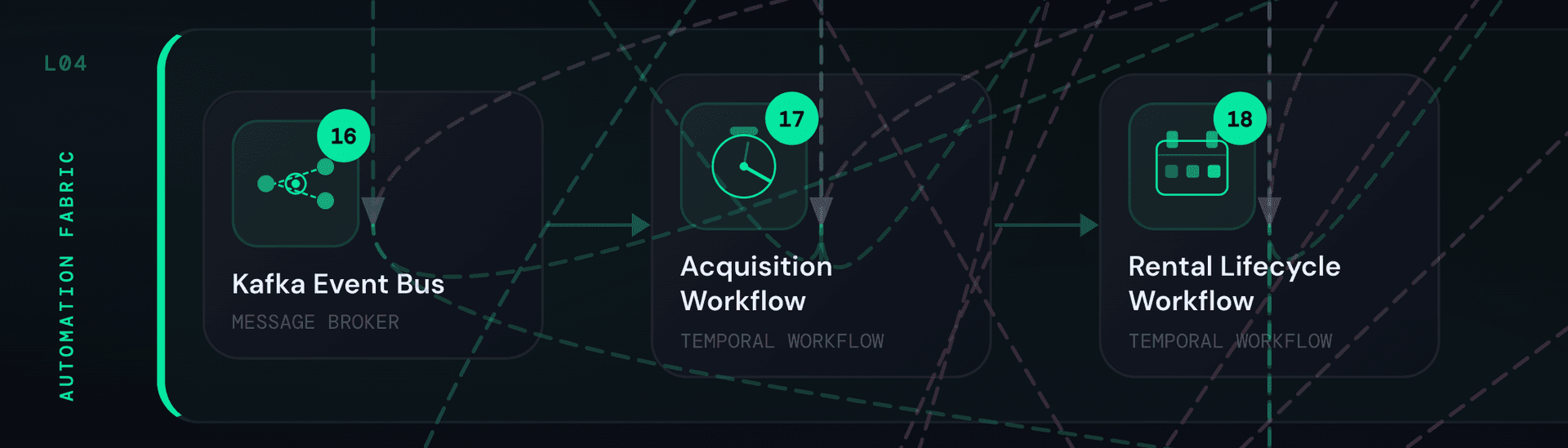
This layer is what prevents the system from collapsing under its own complexity. The runtime is Temporal.io — durable, exactly-once workflow execution with automatic replay on failure. For a system managing financial assets, this is non-negotiable. No workflow ever silently fails.
Kafka Event Bus carries every platform domain event, partitioned by property_id for ordered processing. KEDA autoscales AI agent pods based on Kafka consumer lag — during a major rent collection event, agent pods scale up automatically. registerProperty() fails, all prior steps reverse — no property is ever left in a half-registered state. L04 connects AI decisions to blockchain actions. No dropped steps, no race conditions, no missing state.
L05 — Interface & UX
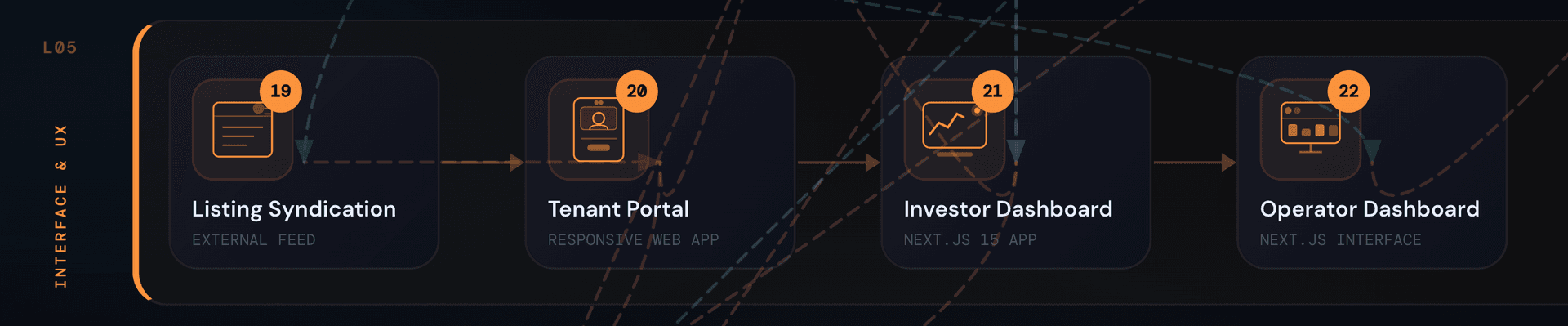
This layer serves the humans. Four surfaces, all built on Next.js 15 with real-time data via The Graph and Socket.io.
L06 — Infra & Observability
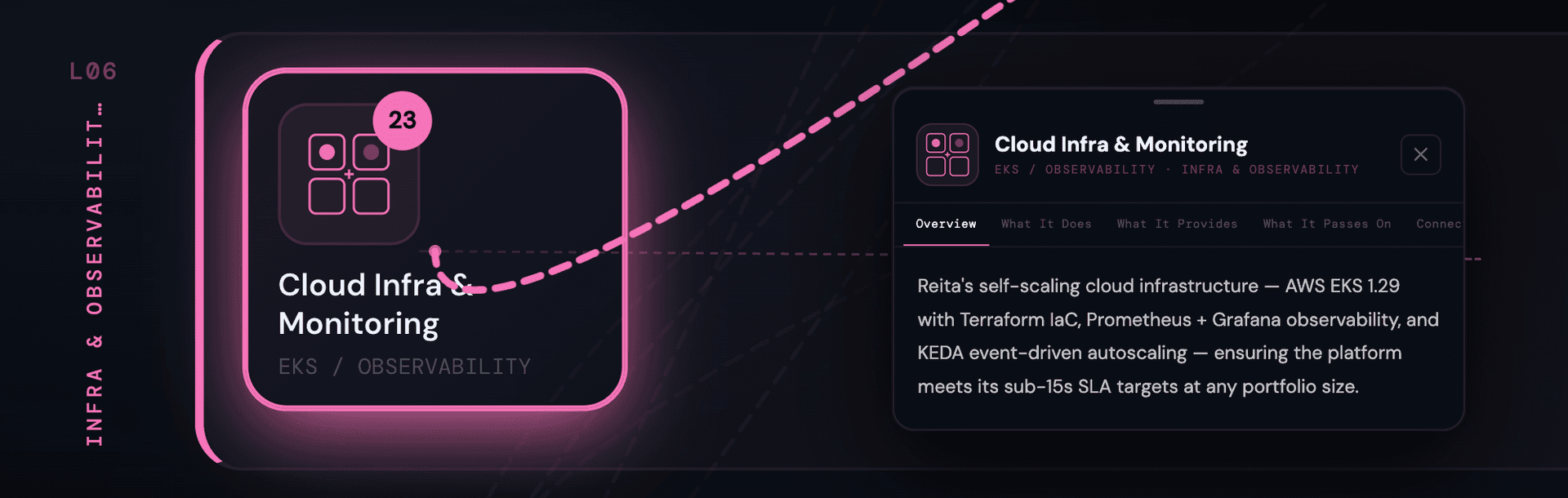
AWS EKS runs all pods. Prometheus and Grafana handle metrics and alerting. LangSmith traces every LangGraph agent call — every prompt, response, token count, model version, and latency — giving a full audit trail for every autonomous decision. KEDA autoscales AI agent replicas 1–20 based on Kafka consumer lag per topic. AlertManager pages on-call engineers for SLA breaches: agent inference over 900ms, lease approval over 12 seconds, dividend distribution over 15 seconds.
Without LangSmith tracing, a prompt regression causing discriminatory lease decisions would be invisible until a Fair Housing Act violation occurred. L06 is not optional infrastructure. It is a first-class architectural requirement.
L07 — Payments & Finance
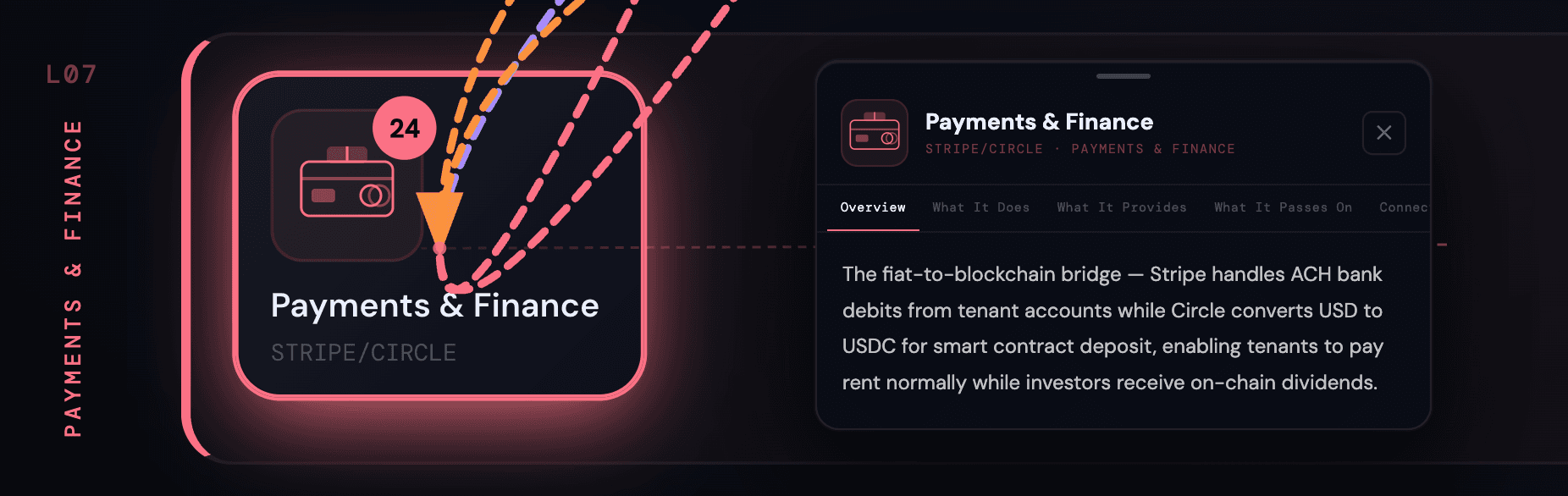
Stripe ACH initiates monthly rent pulls from tenant bank accounts. Once USD clears, Circle converts to USDC at 1:1 parity and routes to the RentEscrowContract on Polygon PoS. Investors deposit USDC directly — gasless, via Circle's programmable wallets API. Dividend payouts flow through the DividendDistributor contract. All payment webhook endpoints are idempotent — Stripe and Circle event IDs are stored in PostgreSQL with ON CONFLICT DO NOTHING, so duplicate deliveries are silently discarded.
L07 is intentionally isolated as its own layer because it sits at the intersection of traditional financial regulation and blockchain infrastructure. Swapping Stripe or Circle for a different provider never touches agent or workflow logic.
End-to-End System Flow Simplified
1. Investment Entry
2. Property Acquisition
3. Tenant Onboarding
4. Rental Lifecycle Activation
5. Rent Collection & Conversion
6. Financial Reconciliation
7. Investor Payout
8. Transparency & Reporting
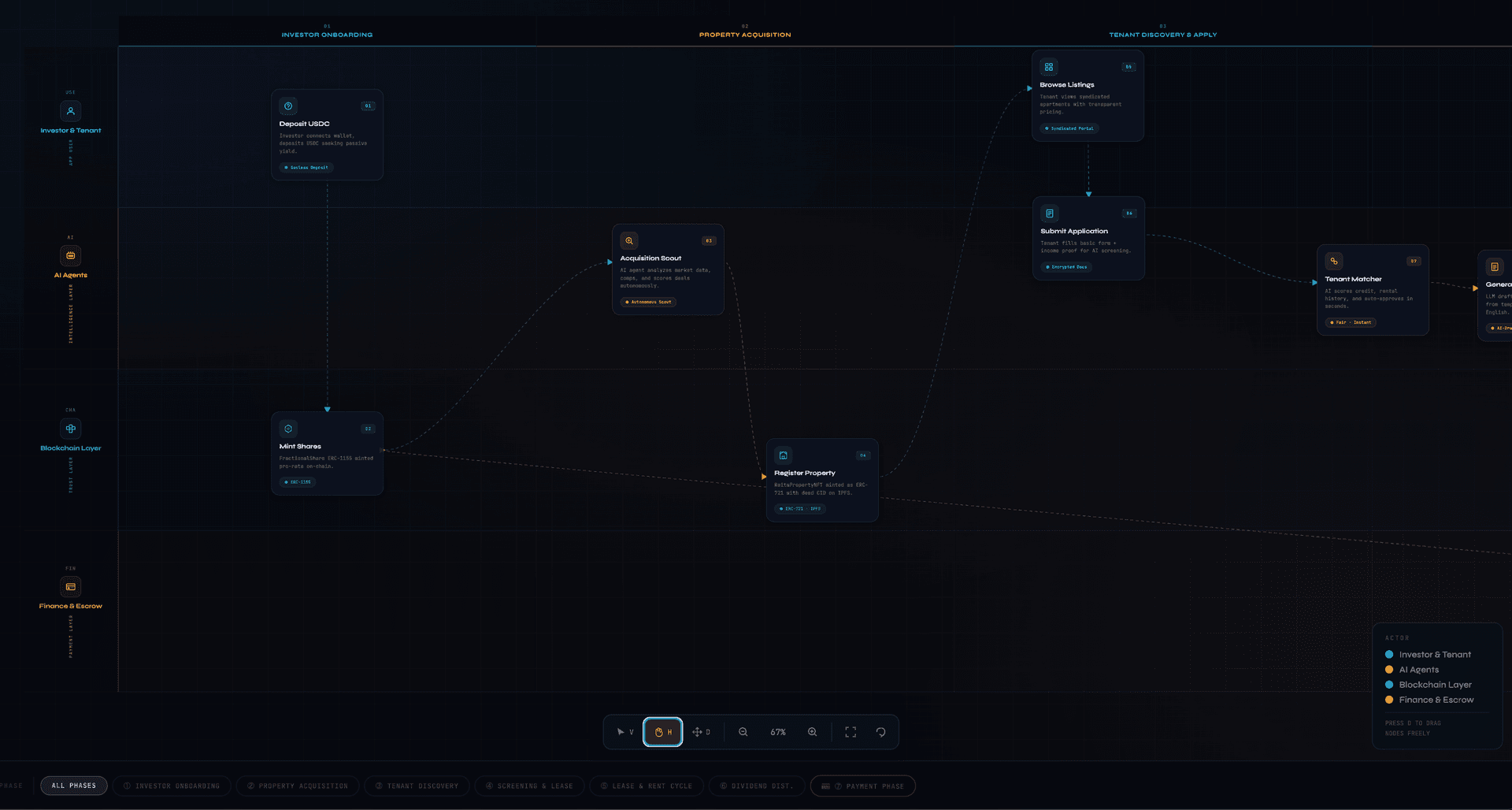
User Experience — How Each Stakeholder Interacts
Three user types interact with this system. Each one used to operate at the mercy of delays they couldn't see or control. Here is what changes.
Investors previously waited months for quarterly dividends to arrive via wire transfer, with no real-time visibility into portfolio performance. In this system, an investor connects a wallet, deposits USDC, and immediately sees projected yield on the dashboard. Shares mint on-chain as ERC-1155 tokens pro-rata to their contribution. Every month, the Financial Steward reconciles income, the DividendDistributor executes the payout, and the investor sees USDC land in their wallet — with a cryptographically verifiable on-chain receipt — within 15 seconds of distribution.
Tenants used to fill out paper applications, wait for a human to review them, negotiate leases through a property manager, and sign documents through a multi-day back-and-forth. In this system, a tenant browses AI-curated listings on the portal or through a Zillow click-through, submits an encrypted application, receives an AI screening decision in seconds, and e-signs a fully customised jurisdiction-specific lease in the same browser session. The security deposit and first month's rent are collected once, automatically, at activation.
Operators used to be the connective tissue holding the whole process together — coordinating between lawyers, accountants, property managers, and banks. In this system, the Operator Dashboard surfaces everything the Supervisor Agent has already handled: every active lease, every maintenance job, every compliance alert, every yield distribution. Human operators are present for escalations — not for routine execution. The system handles the critical path. The operator sets the policy parameters.
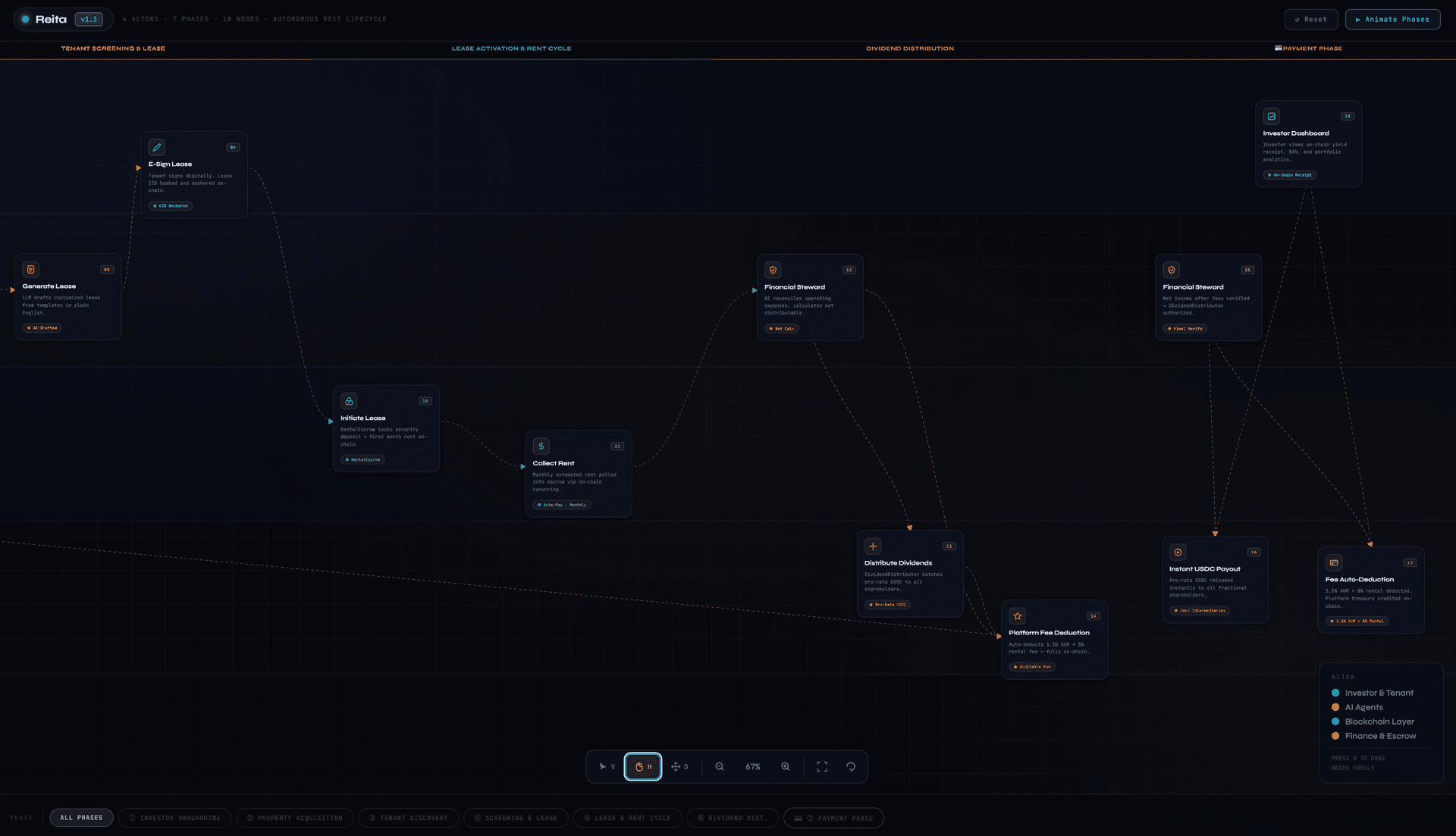
The second phase of the journey map shows what happens after the tenant is approved: lease generation, e-signature, escrow initiation, automated rent collection, Financial Steward reconciliation, dividend distribution, platform fee auto-deduction on-chain, and instant USDC payout to the Investor Dashboard. The entire sequence — phases 4 through 7 — runs without a single human step in the critical path.
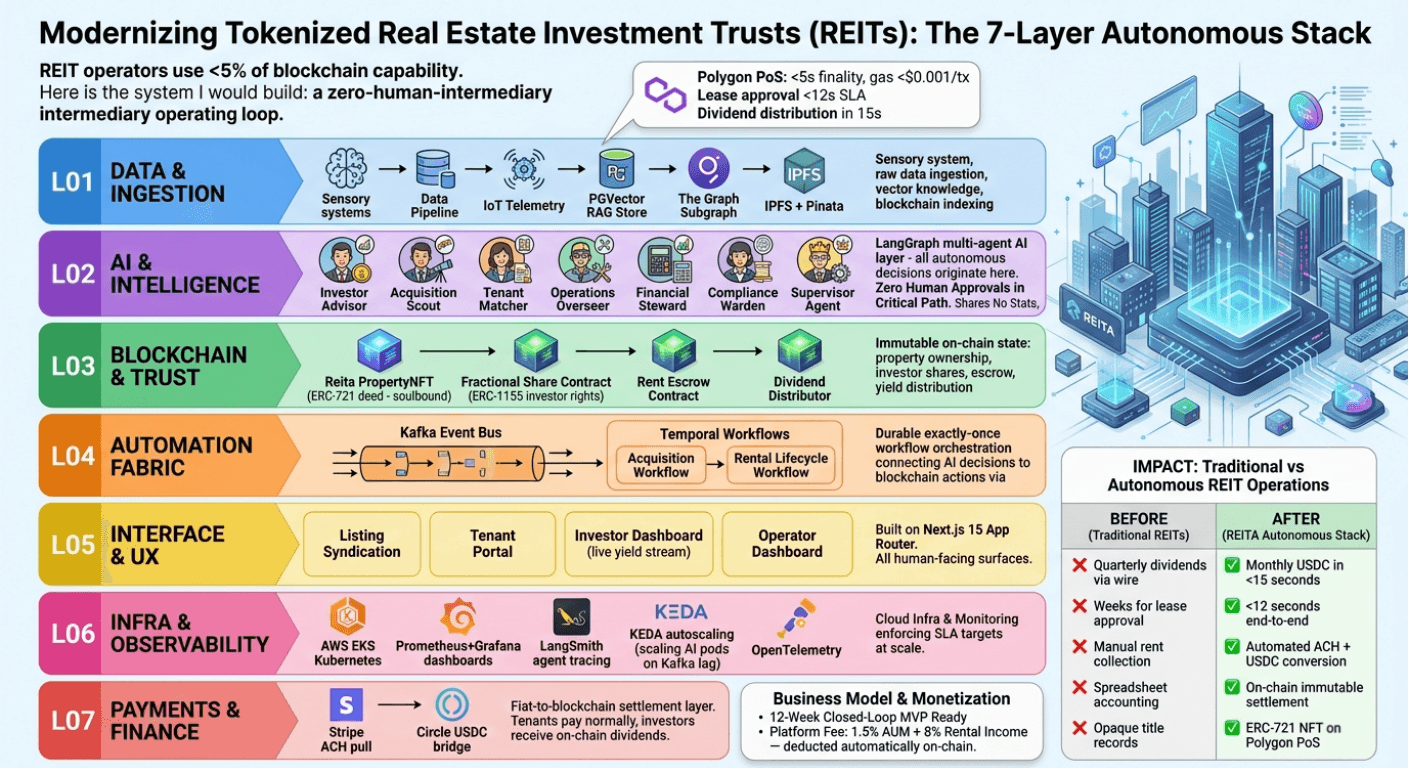
Key Stats & System Summary
Data points to include:
Before vs After comparison:
The Business Case
The revenue model is straightforward: 1.5% AUM fee plus 8% rental income fee, both deducted automatically on-chain before pro-rata USDC distribution to investors. There is no billing cycle, no invoice, no collections process. The contracts enforce the fee structure atomically at the moment of payout. Acquisition generates an additional 2% fee on property tokenization proceeds, and secondary market transfers carry a 0.3% on-chain fee. The SaaS licensing model — $2,500/month for Starter, $8,000/month for Portfolio — adds recurring infrastructure revenue on top of the transactional fees, and enterprise API access creates a third revenue line for institutional processors who want to build on top of the stack.
The defensible position is not the token. It is the data. Every property acquisition, tenant screening decision, rent payment, maintenance job, and yield distribution generates structured, queryable, on-chain data that compounds over time. A REIT operating on this infrastructure after three years has a deal-scoring model, a tenant screening model, and a yield prediction model that no new entrant can replicate quickly. The switching cost for an institutional operator running 500 properties through this stack is not just technical — it is the operational history embedded in the system.
The investor signal: the infrastructure creates a lower cost structure than any traditional REIT operator. No underwriting staff. No leasing agents for routine approvals. No accountants for monthly yield reconciliation. The fixed cost base is the infrastructure, and the infrastructure scales horizontally. A portfolio of 10 properties and a portfolio of 500 properties run on the same stack with KEDA autoscaling handling the load difference automatically.
Strategic Considerations & Real Challenges
The adoption barrier is not technical. It is institutional. Most REIT operators do not have engineers who can build this stack, and most engineers who can build this stack have not run a real estate portfolio. The gap between the architecture described here and a production deployment is not just code — it is regulatory counsel, smart contract audits (Certik or Trail of Bits before any mainnet deployment), KYC/AML infrastructure via Persona and Chainalysis, and the operational change management required to hand routine decisions to an AI agent. Founders who underestimate this timeline end up with a half-finished stack that is worse than the spreadsheet they started with. The realistic closed-loop MVP is 12 weeks for a team that already has the technical depth.
The regulatory landscape is the second friction point. The ERC-1155 fractional shares are security tokens. SEC Regulation A+ caps public issuance at $75M per 12-month rolling period. Regulation D 506(c) limits access to accredited investors only. The Compliance Warden runs five REIT qualification tests daily — 75% asset test, 75% gross income test, 90% distribution requirement, 100-shareholder minimum, 5/50 concentration rule — but a DAO vote and a legal opinion are still required before launch. The architecture handles the technical compliance layer; the legal work cannot be automated away.
The smart contract risk is real. A bug in DividendDistributor.sol that miscalculates a pro-rata split or allows re-entrancy on a USDC-moving function is not a UI bug — it is a financial loss event. The mitigation: OpenZeppelin battle-tested base contracts, re-entrancy guards on every fund-moving function, a multi-firm audit before mainnet, an emergency pause via DAO multi-sig, and DeFi insurance via a protocol like Nexus Mutual. The risk is manageable. It is not dismissible.
The Stack Proves Something the Industry Has Avoided Admitting
The reason traditional REITs still run on spreadsheets is not that blockchain is too complex for real estate. It is that no one has built the operating system layer that makes blockchain the obvious choice at every decision point. This 7-layer stack is that operating system.
In three to five years, the operators who have built this infrastructure will have a data advantage, an operational cost advantage, and a settlement speed advantage that cannot be replicated by a traditional REIT adding a tokenization feature to its existing stack. The question for founders and institutions in this space is not whether autonomous REITs are possible. The question is whether they build this infrastructure now or buy access to it later.
If you are a founder or investor building in tokenized real estate, connect with me for a consulting discussion on designing your own autonomous REIT system — book a session at dappmentors.org/consult (limited to business propositions).
About the Author
Darlington Gospel is an AI + Blockchain + Automation Infrastructure Architect and Strategic Technology Analyst. Founder of Dapp Mentors, Host of Beyond Blockchain, operating through Dapp Mentors. He designs autonomous AI, blockchain, and automation infrastructure for tokenized real estate systems that run without human intermediaries — writing for global enterprise founders, infrastructure startups, investors, technical leaders, business strategists, and AI/Blockchain/Automation architects.