

Most entrepreneurs building in the pharmaceutical space make the same calculation error.
They see "blockchain," "AI agents," and "autonomous workflows" and assume the infrastructure bill is a seven-figure conversation. Something for enterprise. Something for later. So they keep running a $200,000/year operation on spreadsheets, WhatsApp, and an false hope — and call it a lean startup.
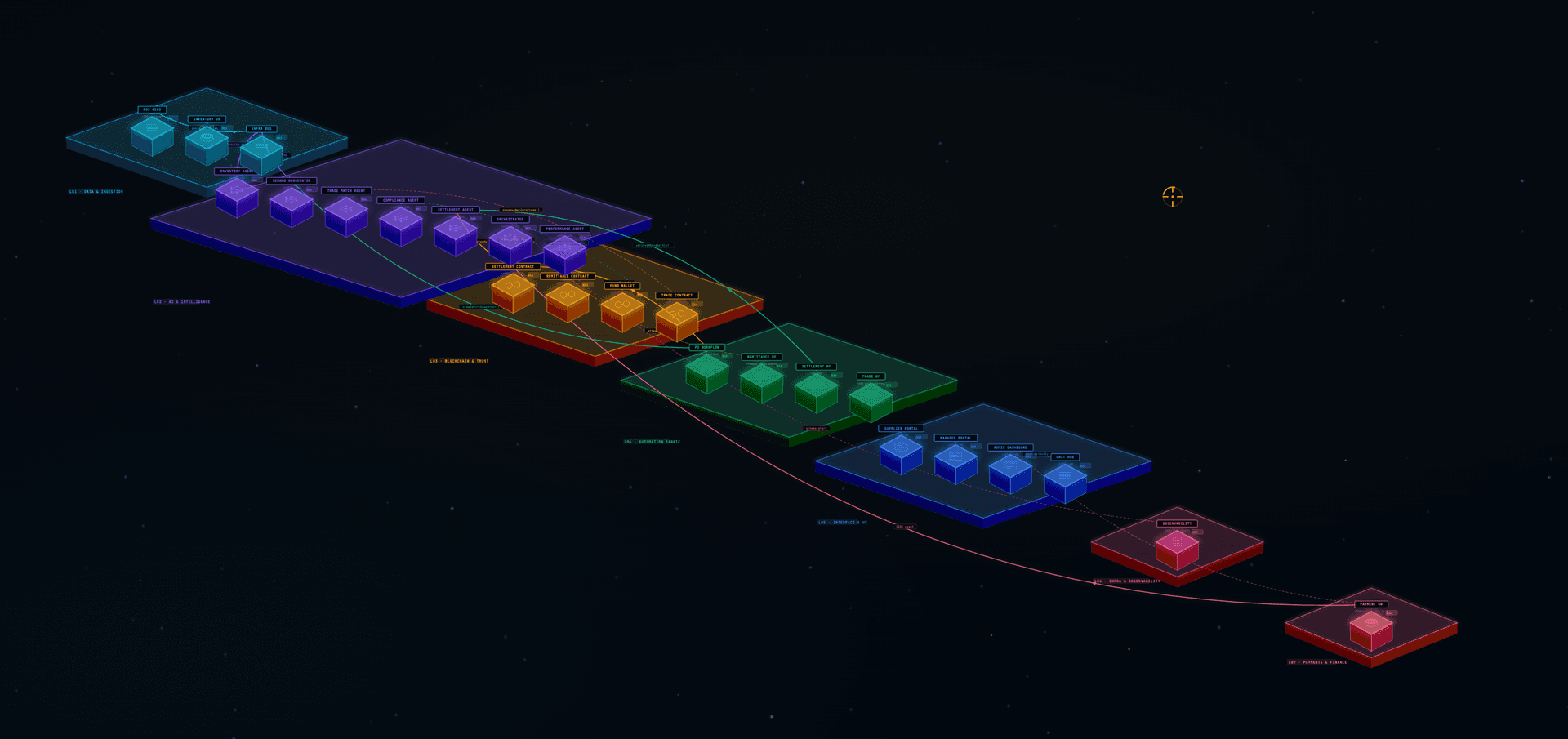
Here is what I want to show you today: a fully autonomous pharmaceutical retail chain operating system — 7 infrastructure layers, 23 system nodes, AI agents making procurement decisions in real time, smart contracts anchoring every payment and compliance record on-chain — running a 5-branch pilot for approximately $3,545 per month in total infrastructure spend.
That's not a cost estimate. That's a production architecture with real numbers, evaluated against live alternatives, across every layer of the stack.
This is the Buduka Stack Reactor — our proprietary framework for evaluating autonomous system viability. And today we're opening the analysis so you can see exactly what it costs to run this at 5 branch pilot scale, what each layer is actually doing for your business, and which decisions you need to make before you write a single line of code.
The Real Question Isn't "Can I Afford This?" — It's "Can I Afford Not To?"
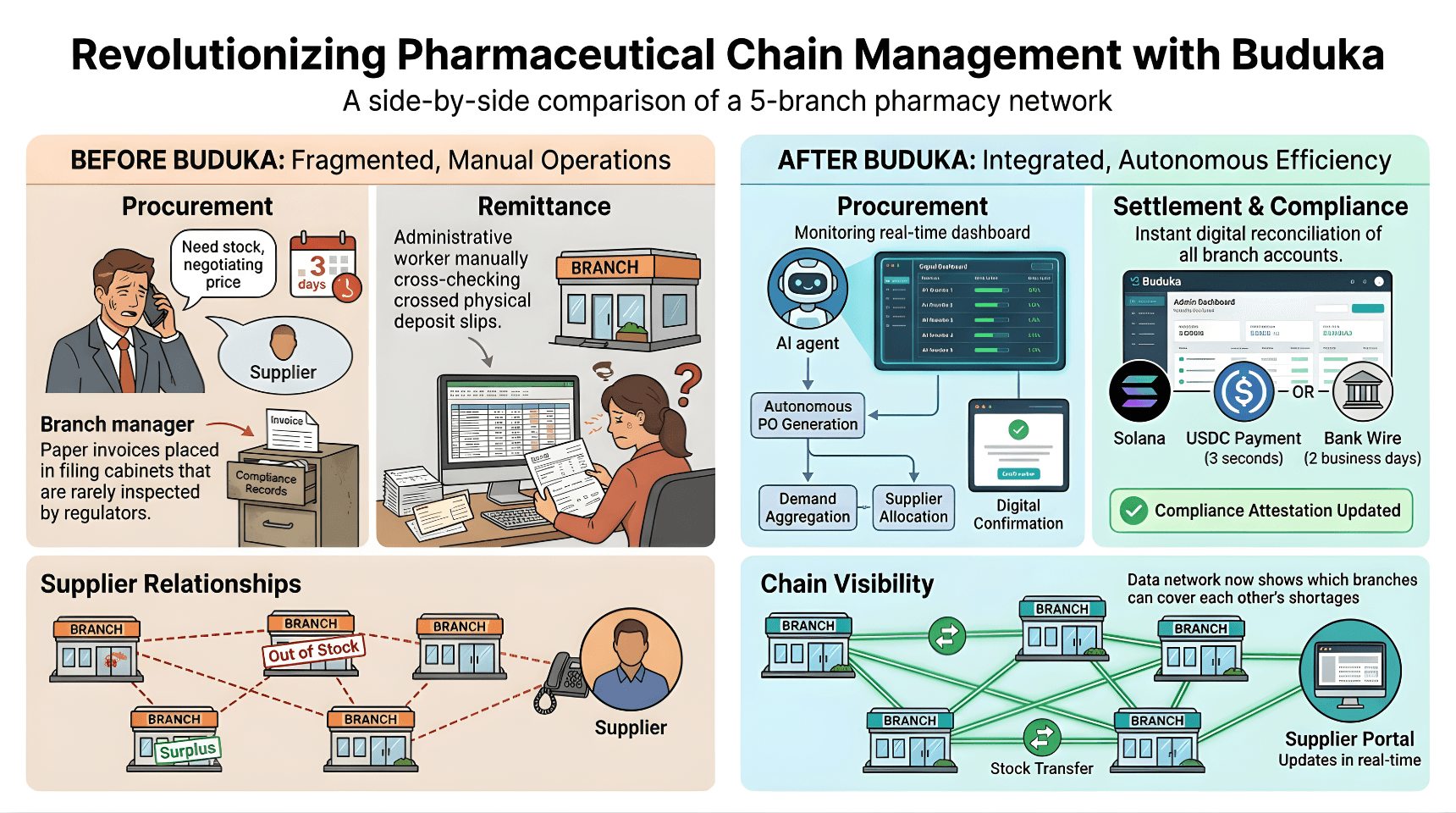
Let me describe what a 5-branch pharmaceutical chain looks like without this infrastructure.
Daily procurement is a phone call.
A manager notices stock is low, calls a supplier, negotiates a price they won't remember in 6 weeks, and waits 3 days for delivery. The invoice arrives on paper. Payment gets wired manually. The compliance record is a folder in a cabinet no regulator has ever actually inspected.
Daily remittances happen on a spreadsheet. Each branch manager submits their end-of-day numbers into a Google Sheet. Someone in administration cross-checks them — manually — against bank deposits that may or may not have landed yet. Discrepancies sit unresolved for days.
Supplier relationships are entirely relationship-dependent. If your main supplier has a bad month, your chain has a bad month. You have no visibility into which branches could cover each other's shortages, because no one has ever built that visibility layer.
Now here is what changes when you run Buduka across the same 5 branches.
Every branch stock level is monitored by an AI agent running every 20 minutes. When stock drops below reorder threshold, the system autonomously generates a purchase order — no phone call, no delay.
Six hours of branch requests get aggregated into a single chain-wide demand profile, scored against supplier performance metrics, and allocated across your supplier network automatically. The purchase order goes out. Funds are reserved on-chain. The supplier portal updates in real time.
When goods arrive and your branch manager confirms receipt, the settlement workflow fires. The payment processes in under 3 seconds for USDC or within 2 business days via bank wire. The transaction is anchored permanently on Solana). The compliance attestation is updated. The administration dashboard reflects it all within 1 second.
This is not theoretical. This is what the numbers behind each layer prove.
The 7-Layer Stack — What You're Actually Paying For
The Stack Reactor evaluates every layer against a composite score across 8 dimensions: Performance, Scalability, Reliability, Simplicity, Cost Efficiency, Ecosystem maturity, Integration depth, and Use-case fit. Each dimension carries equal weight. The scores don't care about hype — they reflect the production characteristics of each tool at pharmaceutical chain scale.
Here is what the active stack looks like, layer by layer, and what it costs your pilot.
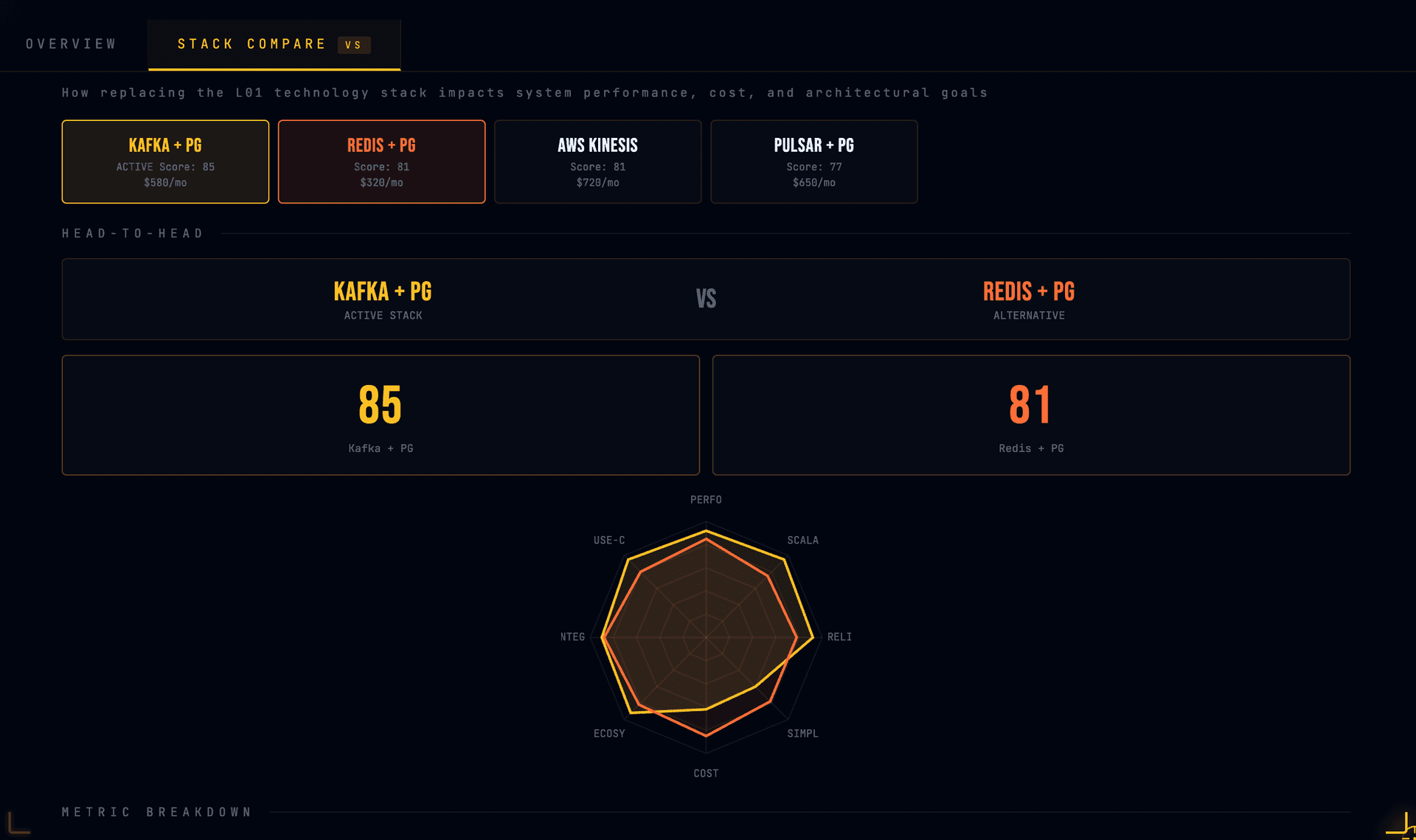
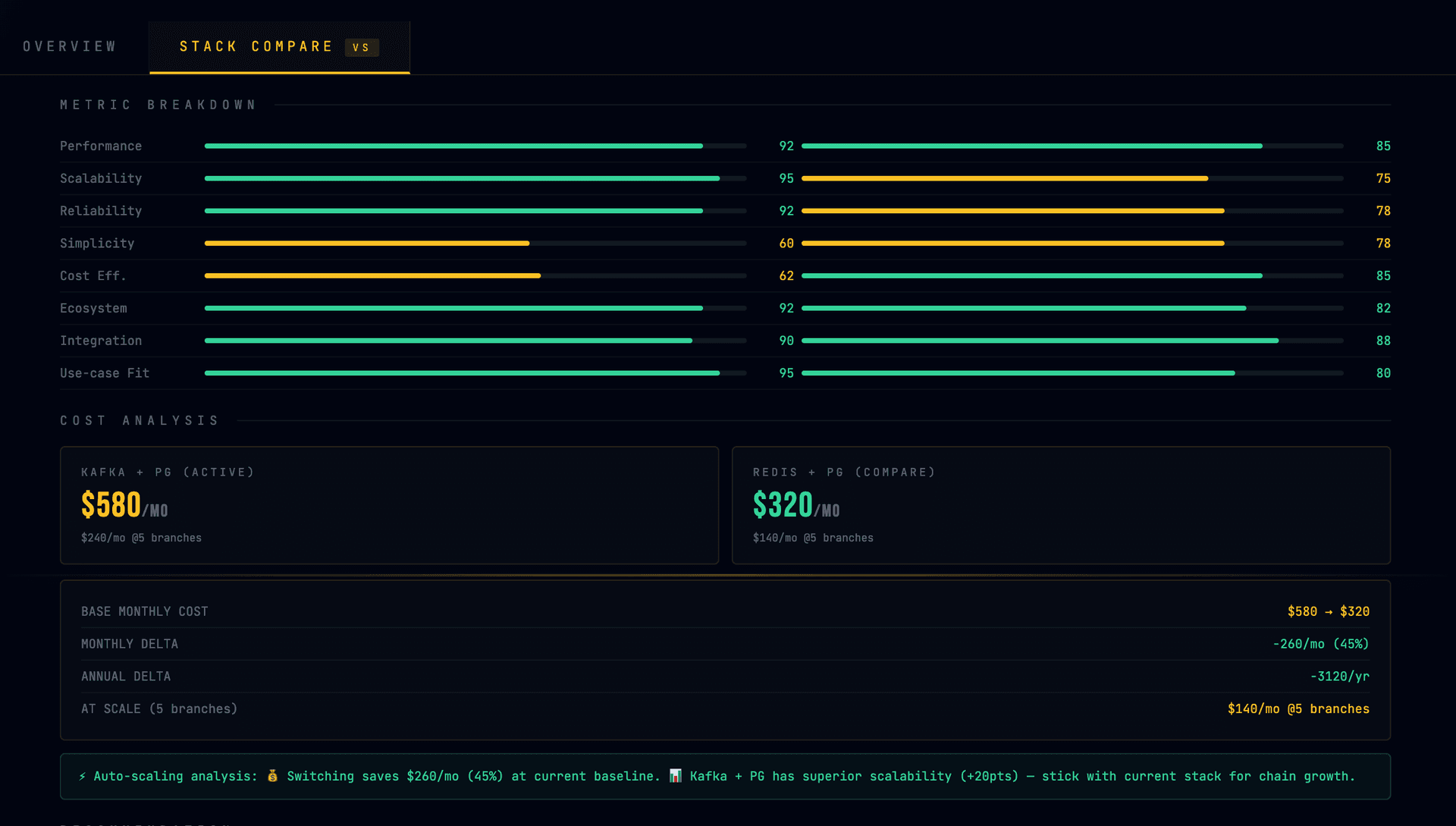
L01 — Data & Ingestion · Apache Kafka + PostgreSQL · $240/mo @ 5 branches
Composite score: 85/100
This is your audit trail layer. Every POS transaction, every stock sensor reading, every GRN input flows through Kafka into PostgreSQL. The system maintains a 7-day event log with schema validation on every record. Dead-letter queues catch malformed data before it contaminates downstream decisions.
The reason this layer matters to a business owner is not technical. It's evidentiary. When a regulator asks for your procurement history, your remittance records, or your inventory movement for any period — this layer is what makes that question answerable in minutes, not weeks.
Kafka scores 95 in Scalability because it was designed for exactly the growth trajectory you're planning: 5 pilot branches today, 50 next year, 500 at enterprise scale. The architecture doesn't change. The cost scales linearly. Redis Streams would save you $100/month here — but with a Scalability score of 75, you'd be rebuilding this layer before you hit 30 branches. The $100/month "savings" would cost you a 6-month engineering sprint.
L02 — AI & Intelligence · LangGraph + Claude Sonnet · $1,900/mo @ 5 branches
Composite score: 82/100
Seven AI agents run this layer. The InventoryAgent monitors stock velocity. The DemandAggregatorAgent consolidates chain-wide demand every 6 hours. The ComplianceAgent validates purchase orders against FDA/EMA drug regulations and issues on-chain attestations.
The SettlementAgent verifies every GRN against the original PO before any payment moves. The TradeMatchAgent identifies when one branch's surplus can solve another branch's shortage.
The model choice here is not a preference decision — it's a risk management decision.
The stack runs on Claude Sonnet for complex compliance reasoning because pharmaceutical supply chains involve controlled substances, regulatory licensing requirements, and sanctions screening. One hallucinated inventory decision — approving a PO for a supplier whose regulatory license is flagged — is more expensive than this layer's entire annual cost. GPT-4o-mini would cut the inference cost by roughly 90%, but it carries a use-case fit score of 75 for this specific task class. You don't negotiate compliance reasoning against a cost savings target. You don't get a second chance on that call.
The monthly cost at 5-branch scale is $1,900. That's your most expensive layer. It is also the layer that replaces the three procurement staff, two compliance officers, and one reconciliation accountant you'd otherwise need to hire.
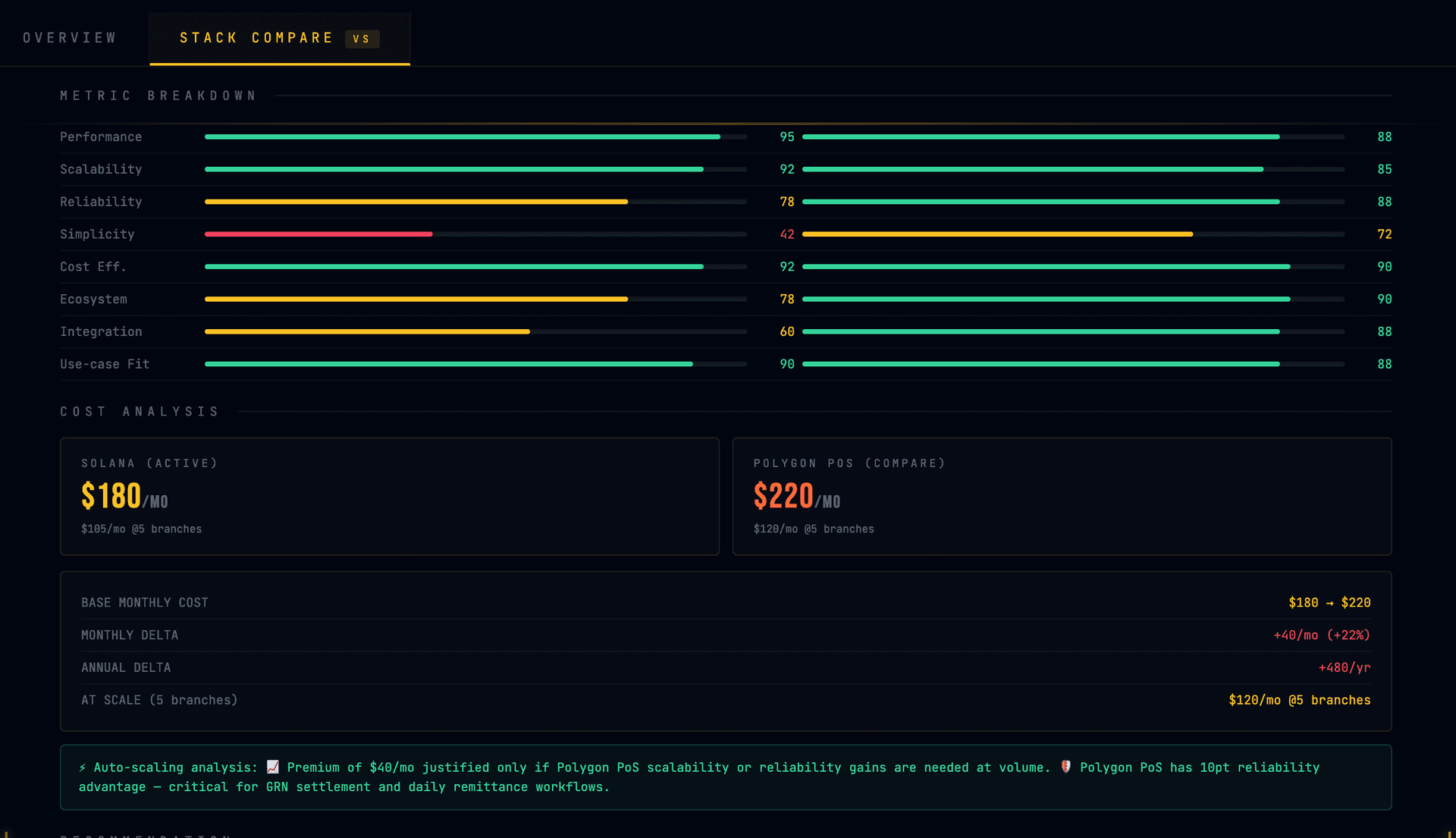
L03 — Blockchain & Trust · Solana (Anchor Framework) · $105/mo @ 5 branches
Composite score: 78/100
Five smart contracts anchor your financial and compliance state on-chain. SupplierSettlement locks and releases USDC when GRNs are confirmed. RemittanceAttestation records every daily reconciliation result permanently. ProcurementFundWallet holds your USDC procurement capital in a Program-Derived Address controlled exclusively by the settlement contract. InterPharmacyTrade anchors every net-zero stock transfer between branches. ComplianceAttestation stores every supplier and drug license validity hash with full revocation history.
Transaction finality on Solana: < 500 milliseconds. Cost per transaction: less than $0.001.
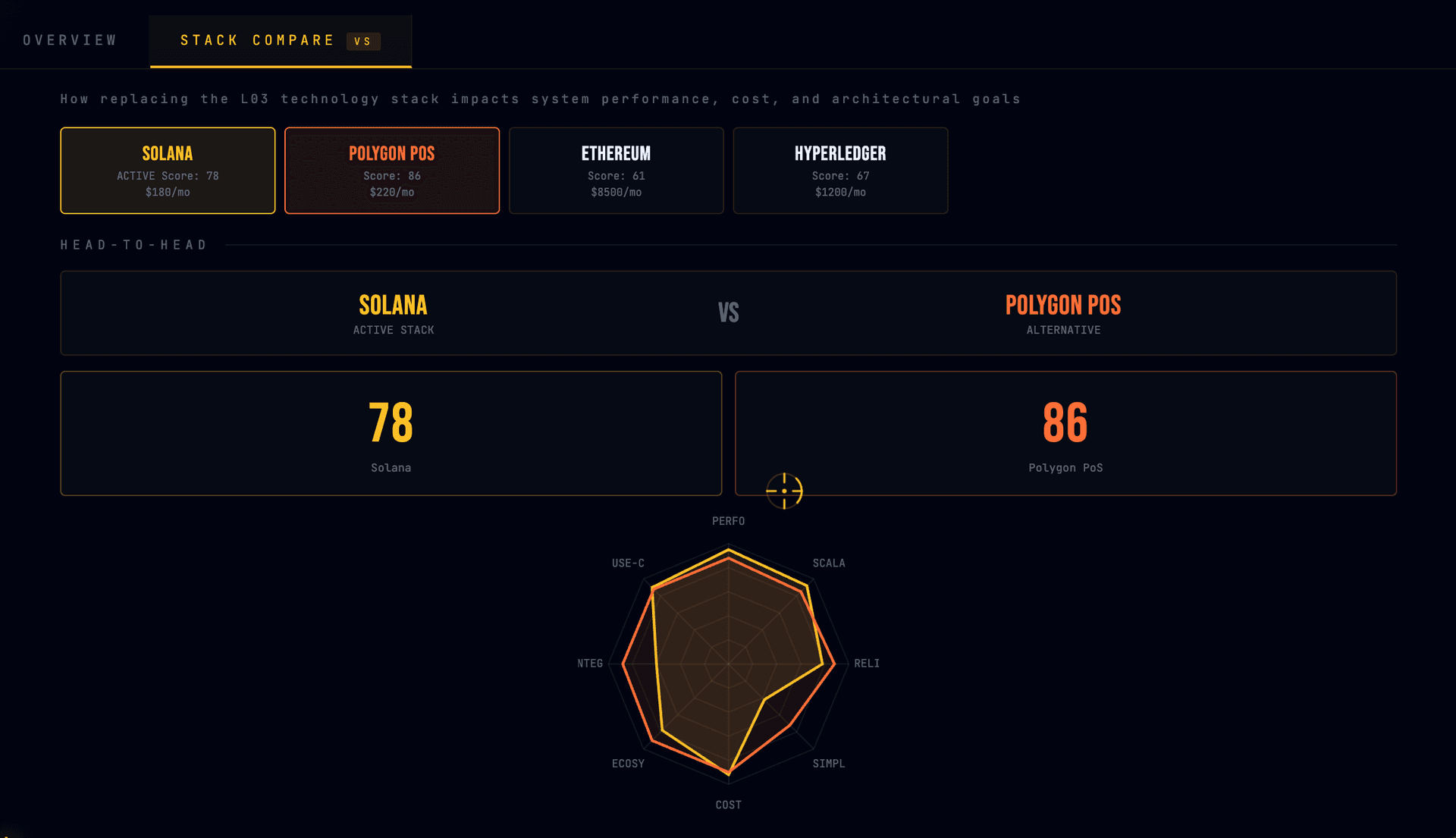
Compare this to Ethereum Mainnet: $8.50 per transaction, 12+ seconds to finality, and $5,600/month at 5-branch scale. Ethereum scores 96 on Reliability — the highest on the board.
But a use-case fit score of 40 and a cost efficiency score of 12 make it architecturally inviable for a system processing daily per-branch remittances, continuous supplier payments, and inter-pharmacy trade records. You'd spend more on Ethereum gas than on your entire AI layer.
Polygon scores 88 on Performance and 90 on Ecosystem — significantly higher than Solana's 78 ecosystem score. But Polygon doesn't meet the < 500 ms finality SLA. And the five smart contract programs in this stack are written against the Anchor framework, which is Solana-native.
Migrating to EVM means a complete contract rewrite. The infrastructure is already designed. Don't pay for a rewrite to land on a slower chain.
L04 — Automation Fabric · Temporal.io · $240/mo @ 5 branches
Composite score: 84/100 · Reliability score: 98/100
Temporal runs every business process in the system with exactly-once execution guarantees. The PurchaseOrderWorkflow generates and submits orders. The DailyRemittanceWorkflow fires at 18:00 UTC for every branch, reconciles POS totals, and anchors results on-chain within 5 seconds. The SupplierSettlementWorkflow handles the GRN-to-payment sequence end-to-end. The TradeExecutionWorkflow fires when both branch managers approve an inter-branch trade.
The reliability score of 98 tells the business story better than the feature list. When a workflow fails mid-execution — server crash, network drop, API timeout — Temporal resumes exactly where it stopped. The business process finishes. Every time.
Celery with Redis would cost $115/month — saving you $125. Its reliability score is 68. In a pharmaceutical supply chain, a dropped workflow isn't a retry error. It's a branch running out of medication, a supplier payment that never arrived, or a remittance reconciliation that missed the compliance window. The $125/month you saved just became a four-figure operational incident.
L05 — Interface & UX · Next.js 16 + Socket.io · $200/mo @ 5 branches
Composite score: 86/100
Three portals serve three actor types. The Supplier Portal shows your suppliers their allocated demand by SKU, lets them confirm fulfillment, submit GRNs, and see payment history with on-chain transaction hashes. The Pharmacy Manager Portal handles inventory views, daily remittance submission, and inter-branch trade approvals. The Administration Dashboard surfaces chain-wide fund status, remittance scorecards, supplier performance metrics, and the escalation queue.
A Socket.io Chat Hub connects all three portals with 5 operational room types that open and close automatically based on system events. A GRN dispute opens a SUPPORT room between the branch manager and supplier. A high-value PO approval opens an ESCALATION room between the manager and administration. All messages are retained for 90 days for compliance audit access.
The practical implication: your suppliers can see what's happening with their payment. Your managers can see what's happening with their stock. Your administration team can see what's happening across the entire chain. In real time. Without a phone call.
L06 — Infra & Observability · LangSmith + Prometheus + Grafana · $480/mo @ 5 branches
Composite score: 83/100
This layer is what separates an AI pilot from an enterprise AI deployment.
LangSmith traces every agent inference: prompt hash, model version, token usage, latency histograms, schema violation detection. When the ComplianceAgent's schema violation rate exceeds 1%, an automated alert fires to the OrchestratorAgent. The SLA target is < 0.5% schema violations across all agents. Prometheus) and Grafana cover infrastructure health — pod status, Kafka consumer lag, Temporal worker throughput.
Datadog would give you a premium unified platform for this layer. It would also cost $1,050/month at 5-branch scale — more than double. You'd be paying $570/month extra for brand recognition.
The custom stack delivers 100% visibility into AI agent behavior and system health at half the overhead. At enterprise scale, you revisit that decision. At pilot scale, capital efficiency is the mandate.
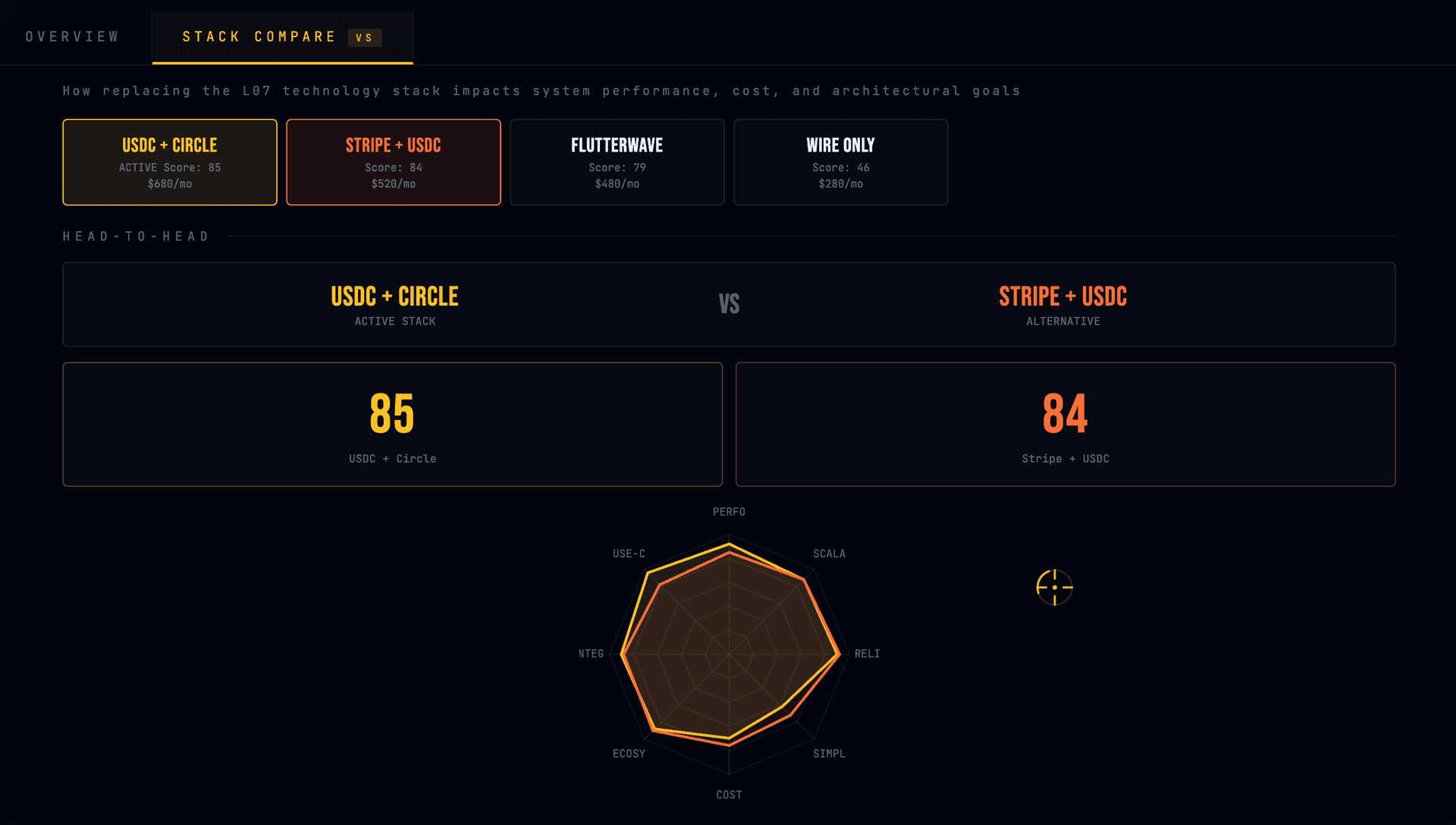
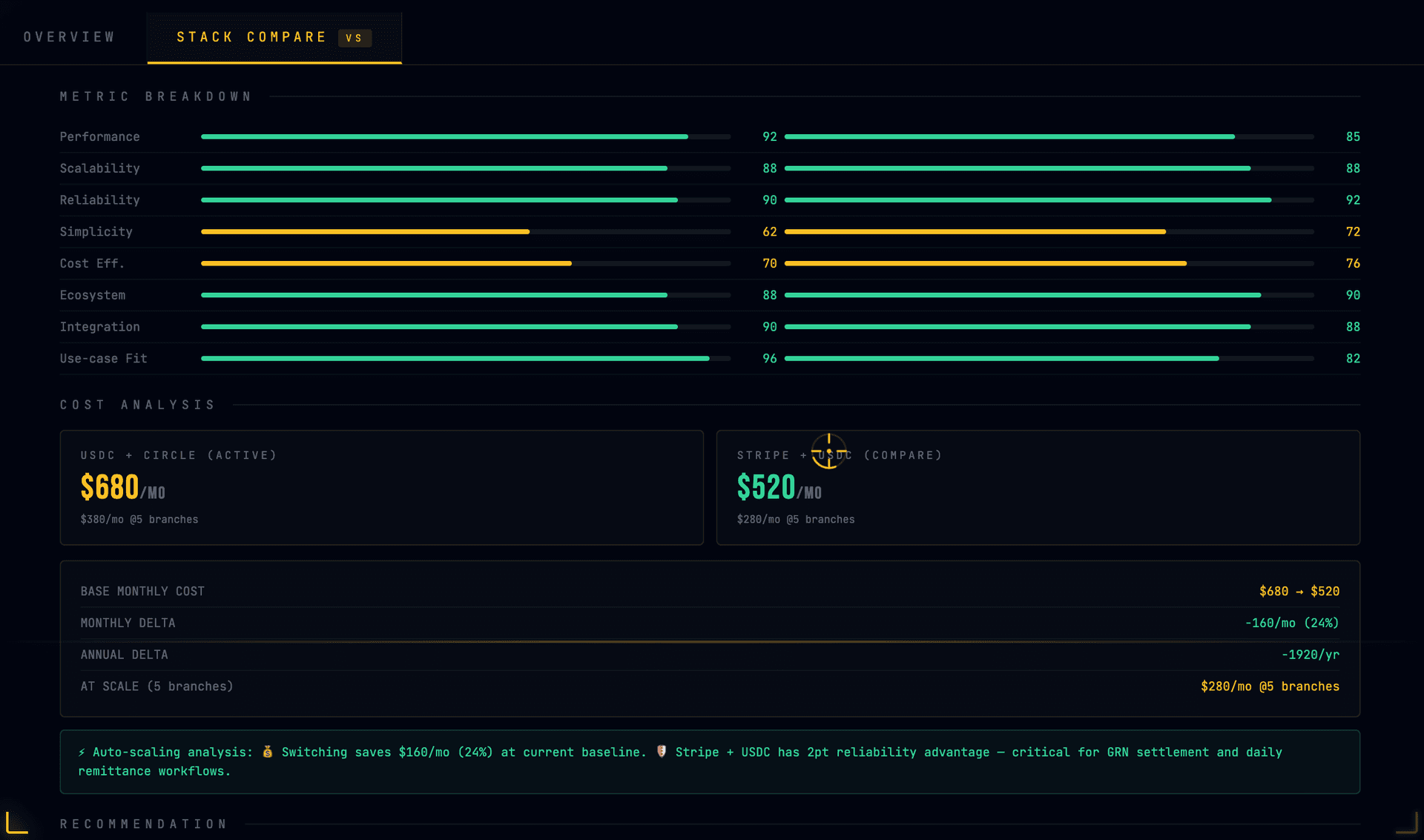
L07 — Payments & Finance · USDC On-Chain + Circle Wire · $380/mo @ 5 branches
Composite score: 85/100
A dedicated Payment Gateway sits between the SettlementAgent and the execution rails. When a supplier with a Solana wallet confirms a GRN, USDC transfers in < 500 milliseconds with blockchain finality. When a supplier prefers traditional banking, Circle Payouts API executes a bank wire in 1–2 business days.
The Payment Gateway broadcasts payment_settled to the Administration Dashboard and payment_complete to the SettlementWorkflow simultaneously. The supplier portal updates. The fund ledger updates. The on-chain record exists permanently.
Wire-only settlement would cost $120/month — saving $260. Its use-case fit score is 15. It breaks every automation in the settlement layer and forces manual reconciliation back into your operations. You didn't build an autonomous operating system to manually process supplier payments.
The Full Pilot Economics — What You're Actually Committing To
Here is the complete infrastructure cost for a 5-branch Buduka pilot, drawn directly from the Stack Reactor production analysis:
5-Branch Pilot Infrastructure Cost Breakdown
L01 — Data & Ingestion
Stack: Kafka + PostgreSQL
Monthly Cost: $240
L02 — AI & Intelligence
Stack: LangGraph + Claude Sonnet
Monthly Cost: $1,900
L03 — Blockchain & Trust
Stack: Solana (Anchor)
Monthly Cost: $105
L04 — Automation Fabric
Stack: Temporal.io
Monthly Cost: $240
L05 — Interface & UX
Stack: Next.js 16 + Socket.io
Monthly Cost: $200
L06 — Infra & Observability
Stack: LangSmith + Prometheus + Grafana
Monthly Cost: $480
L07 — Payments & Finance
Stack: USDC + Circle Wire
Monthly Cost: $380
Total Monthly Infrastructure Spend
$3,545/month
For comparison: a single experienced procurement officer in a mid-size pharmaceutical chain in an emerging market costs between $1,200 and $2,500/month. A compliance manager runs $1,500 to $3,000/month.
A financial reconciliation role adds $1,000 to $1,800/month. That's $3,700 to $7,300/month for three people doing the fraction of what this system does — without the audit trail, without the real-time visibility, and without the ability to scale to 500 branches without hiring 300 more people.
This is not about replacing people. It's about replacing the process infrastructure that limits what people can accomplish.
If you prefer to see the full analysis in action? Watch the full breakdown below of the Buduka stack review and how each layer impacts your business.
What Each Stakeholder Gets — The Day-One Reality
An entrepreneur running this pilot has three user types interacting with the system from day one.
As the chain owner and administrator: You fund the procurement wallet once. You set your spend caps, your supplier allocation weights, your reorder thresholds — once. After that, you review dashboards, not emails. You see every branch's remittance status, every supplier payment in flight, every compliance attestation on record. When something goes wrong, the system has already flagged it and routed it to the right person before you opened your laptop.
Your pharmacy managers: Their daily job changes from "manage procurement" to "review exceptions." The InventoryAgent handles reorders. Managers approve or reject the high-value decisions the agent escalates. They submit daily remittances through the portal — the system cross-checks the amount against POS records automatically and anchors the result on-chain.
When a branch needs stock urgently and another branch has surplus, the Trade module surfaces the match and both managers confirm the transfer. It takes 2 minutes, not a 3-day supplier cycle.
Your suppliers: They join via an invitation link — admin-gated, compliance-screened, 72-hour window. Once in, they see their allocated demand by SKU. They confirm fulfillment. They submit GRNs. They watch their payment arrive. For a supplier who has historically waited 30+ days on invoices, receiving USDC settlement in under 500 milliseconds after GRN confirmation is a relationship-defining moment. Your supplier retention rate changes.
The Honest Risks — What Can Actually Go Wrong
The stack is defensible. The economics work. But three risks need honest acknowledgment before any founder commits capital.
Behavioral adoption resistance. A manager who has submitted remittances via WhatsApp for 3 years will resist a portal submission flow. Not because it's harder — because it's unfamiliar. The mitigation is not training decks. It's a 2-week supervised onboarding per branch where the system runs in parallel with the existing process. You let them see the reconciliation happen automatically before you ask them to trust it.
Regulatory variability across markets. Pharmaceutical compliance requirements differ across markets, with each jurisdiction maintaining its own regulatory authority, drug classification rules, approval pathways, and reporting obligations. The ComplianceAgent addresses this through a configurable regulatory schema layer that can be adapted per jurisdiction prior to deployment. This should be treated as a standard market-entry compliance workstream rather than a product risk. For each new jurisdiction, allocate 3–4 weeks for regulatory schema configuration, validation mapping, and approval workflow alignment before launch.
AI layer cost at early stage. The $1,900/month for L02 represents the highest single line item in the stack. At 5 branches, that's $380 per branch per month for your entire intelligence layer. At 50 branches, the fixed architecture components are largely paid for — the per-branch incremental cost drops sharply. The first-mover commitment requires a founder who can hold the position through the first 90 days before the unit economics normalize.
What This Stack Proves
The argument for autonomous pharmaceutical operations is not abstract. The Stack Reactor makes it concrete.
Every layer has been evaluated against live alternatives with real cost data. Every architectural decision has a score behind it and a financial trade-off attached to it. When you choose Kafka over Redis, you're buying 20 points of scalability insurance for $100/month. When you choose Solana over Ethereum, you're saving $5,495/month while maintaining < 500ms payment finality. When you choose Temporal over Celery, you're paying $125/month to guarantee that no financial workflow ever goes missing.
The founders and chain owners who will build defensible positions in pharmaceutical retail over the next five years are not the ones with the most branches. They're the ones with the most reliable operations, the most auditable financial records, and the fastest supplier payment cycles.
This stack delivers all three, at pilot economics, in a 16-week closed-loop build.
The infrastructure decision you make at 5 branches is the audit trail you'll defend at 500.
Watch the full Buduka Stack Reactor breakdown — every layer scored, every alternative evaluated, every cost delta explained — on the Beyond Blockchain YouTube channel.
Book a strategic consultation: dappmentors.org/consult to evaluate your pharmaceutical chain infrastructure and explore a Buduka pilot for your network.
About the Author
Darlington Gospel is an AI + Blockchain + Automation Infrastructure Architect and Strategic Technology Analyst. Host of Beyond Blockchain, and Founder of Dapp Mentors. Writing for enterprise founders, infrastructure investors, technical architects, business owners, and AI + Blockchain + Automation builders — globally.